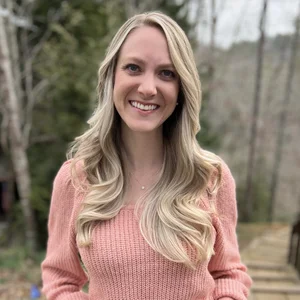
Hey, sweet mama! Have you ever looked in the mirror weeks (or even months) after having your baby and wondered, why do I still look pregnant? You are so not alone. In this episode, I sat down with Camille Beckstrand, a mom of four, certified mental health coach, and co-creator of the Mommy Tummy Fix. We talked about diastasis recti, postpartum identity, and what it really looks like to invite God into the healing of both your body and your heart. Grab your coffee, friend. This one is for you.
🎧 Listen to the Episode
Meet Camille: When Gratitude and Exhaustion Collide
Camille's story starts with her fourth baby, born about eight years ago. Her heart was overflowing with gratitude. Her baby was healthy, and the birth went exactly as she'd hoped. But her body and her mind? They were telling a different story.
She was beyond exhausted, juggling three little ones plus a newborn, and the first few weeks were a blur of sleepless nights and hormones. As she started settling into her new normal, she noticed something was off. Weeks and even months later, she still looked pregnant. Her core felt weak and "loosey-goosey." She had low back pain every single day. She was working out and doing all the things that had worked after her other babies, but nothing was changing.
And quietly, she was comparing. She'd watch other moms at the same stage who seemed to have it all together and think, why can't that be me?
I'll be honest, friend: this hit close to home. I'm seven weeks postpartum with Isaac as we recorded this episode, and my body feels so different than it did after my first two. There's often a gap between what we expected postpartum to look like and what it actually is. That gap is hard, especially when it's not just how your body looks, but how it functions.
What Is Diastasis Recti?
Camille's husband is a doctor of physical therapy, so she brought all of this to him. He had her lie on the floor and tested her for diastasis recti, which is a separation of the abdominal muscles. She had a three-finger ab separation, meaning three fingers could fit in the gap between her ab muscles.
Suddenly it all made sense: the belly that still looked pregnant, the weak core, the back pain. Diastasis recti is actually very common for postpartum moms, and it can linger for years if no one catches it. Camille shared about a 72-year-old woman who came through their program and had never even heard of it. She'd lived her whole life with low back pain, pelvic floor issues, and a "pooch" that turned out to be ab separation.
You don't know what you don't know, mama. If any of this sounds familiar, it's worth asking your provider or a pelvic floor or postpartum physical therapist to check you.
4 Ways Camille Invited God Into Her Postpartum Healing
Camille sensed the Lord whispering that this season wasn't just about fixing her body or hurrying back into shape. He was inviting her into something deeper: letting Him change how she saw herself. Here's what that looked like practically.
1. She traded bootcamps for prayer walks
Her husband gave her a core rehab protocol and told her to bring down the intensity of her workouts. So walking became her foundation, usually pushing a stroller with two kids on scooters behind her. Those walks became her time with God: "I need help. This is where I'm struggling."
2. She replaced negative thoughts with "belief thoughts"
Camille realized she spoke kindly to her kids, friends, and sisters, but not to herself. Hollow affirmations like "I'm perfect just as I am" didn't land in a hard season. So she wrote statements rooted in evidence and in goals she felt God had for her, and she read them every morning:
I am capable of making positive changes to my health.
I can find joy in the process of learning how to take care of me.
I don't have to be perfect, but I can make progress every day, no matter how small.
I make choices from a place of love.
My body is capable of amazing things, and I'm learning how to trust her again.
She spoke them in the present tense, because her growth truly was already in progress.
3. She let go of timelines
Her body had grown and birthed four babies. It deserved grace. Camille chose to trust that God's timeline is different from ours, and that she wasn't going "back" but forward into a new version of herself.
4. She asked, "Lord, what are you teaching me here?"
Camille shared this beautiful truth: pain without purpose is just suffering, but pain with purpose becomes sacrifice. When she reframed her discomfort as a sacrifice for her baby, her family, and God's purpose of bringing one of His children into the world, everything shift
📖 Scripture for Your Heart
"Come to me, all who labor and are heavy laden, and I will give you rest. Take my yoke upon you, and learn from me, for I am gentle and lowly in heart, and you will find rest for your souls. For my yoke is easy, and my burden is light." Matthew 11:28–30 (ESV)
When I asked Camille what she'd say to the mama feeling frustrated with her body or her mental space, she pointed us here. As a little girl, she pictured a yoke as a heavy wooden plank, and she thought, how is that supposed to give me rest?
But a yoke isn't an extra burden. It's a tool for sharing the load. When you're yoked with Jesus, you're walking right beside Him, step by step, at His pace. You can't run ahead. And when you walk that closely with someone, there's a lot of talking and mentoring along the way.
So Camille's encouragement is simple: keep it simple. You don't have to fix everything today. Just take the next gentle step, and invite Him to show you what it is.
It reminded me of watching my two-year-old learn to walk. He fell constantly, but he'd pick himself right back up, wobbly and all. I probably look like that as a mom, a friend, and a wife more often than I'd like to admit. But as His children, we're always under His loving parenting. Just like I tell Ellie, He gently says to us, "Let's try that again."
🙏 A Prayer for You on Your Journey
Sweet friend, if you're feeling discouraged with your body, overwhelmed by all the information out there, or afraid you'll never feel like yourself again, bring it to the Lord. Be gracious with yourself when you look in the mirror, when you miss the gym, or when you eat the thing you said you'd stop eating. He isn't waiting for you to get it right. He's walking with you as you learn. Will you pray with me?
Lord, thank You for the body You've given me and for the miracle of the babies it has carried. I confess that I've often treated my body with frustration instead of gratitude, and that I've tried to carry the weight of this season on my own. Today I choose to take Your yoke and walk at Your pace. In the name of Jesus, bring wholeness to my mind, my body, and my purpose. When fear tells me it's all up to me, remind me that You are holding onto me and will never let me go. Show me the next gentle step, and help me take it in faith. Thank You that this work of motherhood is so challenging and so hard, yet so beautiful and so rewarding. Amen.
📎Resources & Links Mentioned
✨ Christian Mama Birth Prep Library - Free birth prep tools, worship playlists & more
💕 Work with Me 1:1 – Virtual Doula Support & Schedule a Private Coaching Call
✝️ Online Christian Childbirth Education - Explore my complete birth preparation self-paced course
🎴 NEW Christian Birth Affirmation Cards: You can now purchase them here
✨ The Mommy Tummy Fix - Camille's at-home postpartum core rehab program, created with her husband, a doctor of physical therapy
📣 Let’s Stay Connected
If this episode encouraged you:
Hit subscribe and leave a review on Apple Podcasts or Spotify.
Text a friend and share the show with a fellow mama.
Grab your free birth prep tools at the Christian Mama Birth Prep Library.

Meet Your Host —
Natalie is a certified birth doula and childbirth educator in Jacksonville, FL. She's trained through DONA International, certified as a Body Ready Method Pro, and an advanced VBAC doula. Through Faith Over Fear Birth, she equips Christian women to experience peaceful, faith-filled births through both virtual and in-person support.
🔗 More You Might Love
📄 Full Episode Transcript
Natalie: I am so excited to introduce you to my guest today. Her name is Camille Beckstrand, and she is a certified mental health coach and co-creator of a program called the Mommy Tummy Fix, which she built alongside her husband, who is a physical therapist. Camille is a mom of four, and she came into this work through her own postpartum journey: struggling with diastasis recti, wrestling with her identity, and ultimately discovering that God had so much more to do in her heart than just her body.
And that's really what she helps other moms with today: rebuilding their core strength in a way that's safe and sustainable, while also keeping faith, mental health, and wholeness at the center of it all. Camille, welcome. I am so happy to have you here today.
Camille: Thank you. I'm so excited to be with you. This is going to be such a good conversation.
Natalie: I agree. I totally agree. So I would love to get a little more backstory on you. Take us back to your early postpartum days. What was going on in your heart and in your body, and when did you realize that this season of motherhood was going to be about so much more than just physical recovery?
Camille: Absolutely. So like you said, I have four kids, and I mostly want to talk about my last pregnancy today. My youngest is eight years old now, so this was about eight years ago. I had my three other little kiddos at home with me and then this new baby, and my heart was just so full of gratitude, so much thankfulness that this baby was healthy and came into the world. Everything went exactly as I hoped it would. I felt so blessed and so thankful for that in my heart. But my head and my body were almost fighting with my heart. It was almost a battle of, "Oh, I'm so tired. I'm beyond exhausted. What was I thinking, having a fourth child when I'm barely keeping up with three?"
Honestly, those first few weeks after having my fourth were such a blur: lack of sleep and hormones. After those first few weeks, when you start to figure out this new chapter and this new normal, I felt like I started to be a little more in tune with my body, physically, emotionally, all of it. Physically, weeks and even months after giving birth to my fourth child (I was in my mid-thirties by the time I had her), I still looked pregnant, and I couldn't figure out why, because I had started to work out. I was doing all the things that I did with my other babies. Why wasn't it working this time? My core felt so weak. Everything just felt loosey-goosey. And I know it takes your body a long time to come back together after pregnancy, but this time especially, something was off. I had a lot of low back pain every day, and I thought, "Oh, it's got to be from breastfeeding. It's got to be from carrying a car seat."
I just thought this was part of the experience of having a baby, and I physically felt beat down. I should say first that my husband is a doctor of physical therapy. I came to him with all of these things and explained, "Look, I'm working out. I'm trying to take care of my body. I still look pregnant. My tummy is still sticking out. I can't figure out why my core feels so weak, and I have this low back pain." And he said, "You know what? Let me test you for something that I see in a lot of people in my clinic." I said, "Okay." So he had me lie on the ground and tested me for what is known as diastasis recti (people pronounce it both ways), which is an ab separation.
When he did this little test on me, it turned out I had a three-finger ab separation. If you were to line up three fingers, you could stick them in between my ab muscles. That's how far apart they were separated. And he said, "No wonder you still feel like your belly is protruding, like you still look pregnant. It's because you have this condition." So that's what was going on physically.
Emotionally, I was just confused. Why doesn't this feel like it should? Why am I working out and nothing's changing? I was almost frustrated with my body that it wasn't changing, even though I thought I was putting in the work I needed to. I also had a lot of quiet comparison going on. I never really said it out loud, but I was always observing other moms who were maybe as far along in their postpartum journey as I was, or who looked like they had it all together, caring for their kids and taking care of their bodies, and they looked great.
And I thought, "Why can't that be me? Why can't my body look that way?" It was interesting how much it was about my body. And at this time, I felt those quiet whisperings that this isn't just about fixing your body, and it's not about hurrying to get back into shape. It was almost as if God was inviting me into something deeper, something more, a bigger lesson to learn. It was more about letting God change how I saw myself in this season of life. And that's when I hit a turning point.
Natalie: I love that. It's such a relatable experience, because I feel like there are so few women who experience that postpartum time, especially their first time (granted, you're speaking to your fourth), where it's everything you ever wanted, you "bounce right back," and you just feel great and look great and all the things. I feel like for most of us, there's an expectation, then there's the reality, and then there's the gap between those two. And it's really hard to match those up and to deal with how it feels when reality doesn't meet your expectation. Especially when it's your physical body, where not only does it not look the way you want it to, but it's not functioning the same way.
Honestly, you're speaking my language right now, because I'm seven weeks postpartum, and I'm noticing that I feel so different in my body than I did with my other two. So I love how relatable your testimony and your story are, because I feel like so many of us get to this point. And you're right, there is a deeper message than just wanting to look and feel better in our bodies, or get back to where we were. The Lord really is inviting us into something: "Hey, I have something deeper for you. I have something better for you than just the way you look at yourself in the mirror." There's more to our identity than just our looks and the way we feel about ourselves.
So to piggyback on that, what did it actually look like for you to invite God into your healing? Because I think a lot of us moms want to see that played out practically, right? What does that actually look like? It is very hard to make that connection, especially when you're dealing with so much change in your identity once you become a mom, especially that first time. But even if this is your third, fourth, or fifth baby, things are shifting yet again.
Camille: Yes, absolutely. I love that you asked this, because I love to hear people's experiences too, and I always want to know, "But what did you actually do? What was the thing that you did?" So for me, after my husband tested me and we figured out I had diastasis recti, which is actually quite common for postpartum moms, he outlined a protocol for me to follow. Part of that was core rehab exercises, which I did. The other part was that he said, "I want you to bring down the intensity of your workouts. The workouts you're doing are pretty intense. You jumped right back into the workouts that a twenty-something who doesn't have kids might be doing. You are a mom of four in your mid-thirties. You need to honor your body. One of the ways you can show God how grateful you are for the gift of your body and what it was able to do is to honor Him, even in your workouts. So bring the intensity down. Stop using workouts as a punishment to get back to where you were, and use them as a way to connect with your body and show gratitude for it."
So I went from bootcamps at the gym, waking up at the crack of dawn, to walking, which became the foundation of everything I did. Most of the time it was me pushing a stroller, with two kids behind me on scooters. The oldest was in school at that time. We would go on these daily walks, and on top of watching the kids, that was usually when I would talk to God. I would just say, "I need help. This is where I'm struggling. This is what I'm dealing with."
One of the thoughts I had after one of these walks, where I was pouring out the things that were hard, was that I needed to start replacing all the negative thoughts in my head with truth. I speak kindly to my kids. I speak kindly to my girlfriends. I speak kindly to my sisters. We're taught to be kind, and He wants us to also be kind to ourselves. But sometimes those negative thoughts take over, and that voice in our head tells us things that aren't very kind. I really needed to work on that.
So I took these walks, I talked to God, and I worked on my negative thoughts. I called my replacements "belief thoughts," because I just needed a belief in something. The definition of belief is an acceptance that a statement is true, or having confidence in something. I think sometimes we think, "Okay, I've got to replace my negative thoughts with positive ones," so we start saying things like, "I'm perfect just as I am." But that felt hollow to me, especially in a season of struggle. It just doesn't land.
So instead, I tried to create personal statements that were rooted in evidence, things I couldn't deny, and also things tied to goals I had for myself and goals I felt God wanted me to have for myself. When the negative thoughts would creep in, I would start saying things like this to myself. I wrote them down and read over them every morning. Here are some of the things I had written down:
I am capable of making positive changes to my health. I am worthy of investing time and effort into. I can find joy in the process of learning how to take care of me. I don't have to be perfect, but I can make progress every day, no matter how small. I am in control of my choices, and I can make healthy ones. I make choices from a place of love. My body is capable of amazing things, and I'm learning how to trust her again.
I would speak these thoughts in the present tense, even though I didn't feel like I was there yet. I wanted my brain to start thinking as if my growth and these changes were already in progress, because they were. So those were two of the things I did: I went on walks and talked to God, and I learned how to combat those negative thoughts. It didn't work all the time, but it did help.
Another thing I did was let go of timelines. My body had grown and given birth to four babies. I needed to give her some grace, let go of this unrealistic timeline, and recognize that it might take longer than I thought to feel strong again, to feel in control of my body again, to not feel so loosey-goosey anymore, and to feel like everything was back. Well, not "back." I don't like to think about going backward, but moving forward into this new version of me that I had become. Part of that was recognizing that God's time is different from my time. He has a purpose in His timeline, and I had to trust in His timing and how this was going to work out.
And the last thing I did, which I heard on a podcast somewhere and it has stuck with me, was to make part of my prayer walks and conversations with God asking Him, "What are you teaching me here? What is it that you need me to learn from this?" Pain and discomfort without purpose is just suffering, and I don't think God wants us to suffer through our lives. But pain and discomfort with a purpose is a lot of times sacrifice. I felt a lot of pain because of my body, physically, mentally, and emotionally. But when I reframed it as a sacrifice for my baby, a sacrifice for my family, a sacrifice for God to bring one of His children into this world, suddenly my pain and discomfort had a purpose. And I just knew, "Okay. If God has a purpose for this, He's got a plan, and I know it's going to work out." So inviting God in didn't mean I suddenly had it all figured out. It just meant I didn't have to do it alone anymore.
Natalie: That's beautiful. I especially loved what you said about not using workouts as punishment, because even if we don't cognitively realize we're doing it, there's a subconscious way we restrict ourselves from eating certain things or work out super, super hard, and it becomes a punishment, or a way of trying to avoid something. And that is not at all how we can honor the Lord in taking care of our bodies. Stewarding our bodies is going before the Lord and saying, "You've given me this body, You've given me this mind, You've given me these babies, whatever it is, and I'm just going to do the best I can to honor You with those things." So I'm not working out to punish myself. I'm doing this so I can be healthy, so I can serve the purpose and the things You have for me.
And as a sidebar, I get back into shape. But we don't want to aim for just that end, because if we aim for that end, the goalpost is always going to move. I think that's what's also really frustrating about having a goal like a certain weight or a certain size: it's always going to be moving and changing, and gravity and time are always going to be working against us. So if we set our hearts and minds on just that end, we will be disappointed.
But if the goal is to steward the body the Lord's given us and to view that effort as worship to Him, that we get to worship Him through it, that is where I enjoy my workouts the most. Even if I didn't do a ton of weights that day or whatever, I'm just like, "Lord, this is all worship to You." I get to come in here, and I don't have to compare myself to anybody else or what anyone else is doing, because it's not about them. And that's what I want to be a part of, not striving just to strive and always being disappointed in myself.
Unfortunately, I feel like that's how most of us think about fitness and getting, like you said, "back" into shape. But we're moving forward. We're not going back. We're moving forward. I love that.
Camille: Yeah.
Natalie: Before we jump back in, if you're listening to this conversation and thinking, "Okay, but how does this apply to my situation?" that's exactly what virtual birth support is for. We take everything you're learning from episodes like this one and work through what it looks like specifically for you. You can learn more at faithoverfearbirth.com or visit the link in the show notes.
Now, back to the conversation.
Tell me more about the Mommy Tummy Fix. What is this program, and who is it for? I feel like your journey and your husband's expertise were kind of leading you both to this point, but I would love to hear more about it.
Camille: Absolutely. So after my husband tested me for diastasis recti, and after I started this protocol of core rehab exercises and lower-intensity workouts, my husband asked me, "Would you be okay if I photographed you doing all of these different core rehab exercises as you do them?" And I said, "Okay." Little did I know, he had the impression that postpartum rehab is not available to all moms. A lot of times there aren't physical therapists who specialize in postpartum rehab, and a lot of times it's not covered by insurance, so it gets really expensive. And, sweet mamas, it is so hard to find time two to three times a week to go see a physical therapist for rehab, find a babysitter for your newborn, and, if you have other kids, juggle those schedules.
He has worked with a lot of moms in his clinic, but he knew how hard it was for them to come in, and a lot of them would drop off after an appointment or two. He said, "They still need help, but I can't help them from my clinic. I want to make postpartum rehab available to women at home, on their own time." So that's why he took pictures of me doing all the core exercises and progressing through the rehab. He also has a background in personal training, so he knows the things that women especially need to do after having a baby to best take care of their bodies in this season of their lives.
We call our program the Mommy Tummy Fix. A lot of people say, "You don't need to fix anything. You're not broken." But one of the definitions of the word "fix" is to make whole again, to bring back together stronger. That's why we named it that. We want moms to feel whole, to feel like they've come back together in this new season of their lives even stronger. That's what it's about.
Obviously our focus is on core rehab, which is where the "mommy tummy" comes in, but as part of our program we also include the low-impact, steady-state exercises we recommend, and simple nutrition guidelines. No diets, just frameworks that teach you how to feed not only yourself but your family, in a way that gives you energy and helps your hormones. We brought in a registered dietitian and nutritionist for this part, because we aren't qualified for that. She created mini classes that moms can watch three minutes at a time to learn the nutrition basics of how to steward their bodies, and do it for the rest of their lives.
Our goal and purpose was to be a response to the confusion around health care for moms. A lot of what's out there on social media, or what you find if you Google things, comes from personal trainers who maybe haven't had a baby, or fitness influencers who are in a different season of life and have time to devote to taking care of their bodies at a level most moms don't. So we wanted to give moms simple frameworks they could do at home with their kids on the floor next to them, and that they could follow for the rest of their lives. Almost like a bridge from chaos, fear, and the unknown to clarity. A lot of moms, and I felt this too, just feel overwhelmed by all the information out there. It's so much. How do you know what's right for you? How do you know what's safe for you? That's why we said, "We've got to make it simple."
So we focus on core rehab. Even if you don't have diastasis recti, you can still benefit from having a strong core. Your core is your powerhouse. Every movement you make, you feel it there, and there are so many muscles and muscle groups that play into it, including your pelvic floor, which is so important. Core rehab is the foundation of everything we do. Not workouts first, not burning fat. Core rehab. Build a strong foundation, and from there we take simple, sustainable, doable steps. We build on simple habits you can fit into your life every day, because it should support your life, not take over your life.
I think the underlying thing is that our focus is real life for moms. You're going to have days with sick kids. You're going to have days when your energy is so low. You're going to have days when you just aren't feeling it. It's not about pushing harder; it's about learning how to rebuild smarter. And a lot of women don't even know this option is available to them. They don't know that building core strength is something they can do not only six to eight weeks postpartum, but also six to eight years down the road.
We even had a 72-year-old woman come through our program who had never heard of diastasis recti or ab separation. She went her whole life with low back pain, pelvic floor dysfunction, and what she described as a little pooch in her belly, but it was actually her ab separation. Sometimes your insides start to poke through that separation, and that's why a lot of times you still look a little pregnant: a mommy tummy, a pooch. It's usually because of this condition, and it just breaks my heart. So that's where the Mommy Tummy Fix was born. It has been incredible to watch its journey and its reach, and we're still learning how to share it with other people. We even have people in India who have used our program to heal and recover postpartum. It's beyond my wildest dreams what God has been able to do with this.
Natalie: That's awesome. A couple of things came to mind for me. Number one, you don't know what you don't know, like that 72-year-old woman who went her whole life with these issues, not even realizing, "Oh, I don't have to deal with this." But then there's also, like you said, the fire hydrant of information on the internet, and it's overwhelming. You're right, figuring out whether something is even appropriate for you and your situation is really difficult. So I love that your program is available and so specific to moms in this season. I also love that you're a fellow believer and that there's that heart behind it: this is not about striving.
Something you said when we were offline is that choosing faith over fear doesn't end in the delivery room, and I love that. Can you unpack that a little more? What does that look like in real life?
Camille: With every pregnancy and every labor and delivery, it's a hard process. I never had super easy pregnancies. I wasn't one who loved being pregnant. I was grateful, but it was hard. And yet I felt like through my pregnancies and through labor and delivery, I chose faith over fear so much. I leaned on God so much, asking Him to bless this baby growing inside of me and to help me take care of my body, just leaning on Him to carry me through that season.
After birth, I don't know if it was the lack of sleep or the hormones, but everything felt big and overwhelming, and sometimes I forgot how much I needed to lean on my faith. It was almost like my fear shifted and became so big that it took up all the space in my head, and even in my heart sometimes. My fear would shift to my body: "I don't know if my body will ever feel good again. Will I ever feel like myself again? Will I ever get enough sleep?" But I also had fears like, "Am I behind? Is my baby behind in his development and growth? Am I teaching my kids what they need to know? Am I doing this right?"
Fears are so big in motherhood. They can be so overwhelming. Same with health and fitness. We can be inundated with so much information, and it can be overwhelming to know the best way to be a mom and the best way to take care of my body, while learning this journey of motherhood, caring for a little one (or many little ones, if you've had a couple of babies), and still finding time to take care of yourself so you can show up as the best mom, the best wife, and the best version of yourself. What I've learned in this process is that faith isn't a one-time moment. It's literally a daily practice, even an hourly practice, of remembering to choose faith over fear.
For me, with my four kids (my youngest is eight, my oldest is 18, and I've got a couple of teenagers in the middle), some examples are choosing patience over panic. With all the different situations my kids are in and the stages they're at, a lot of times my heart will go to panic: "Oh my gosh, I don't want you to experience that. I need you to be safe. Is that the right decision for you?" And instead, I choose patience in the journey God has for them, and I lean on Him. It's also trusting God's timeline, not only in healing and recovery, but His timeline for each of my kids in their own journeys and their own walks with God. Especially as my kids get older, I've really had to lean into faith in that.
Letting go of comparison is a huge one for me. Even though I'm way past postpartum, I still find myself comparing, not only bodies, but lifestyles, and hair. I've got gray hair coming in, and I'll think, "She has no gray hair." The littlest things. I have to let go, turn it over to God, and lean into faith that this is the body God gave me. This is the life God gave me. God put me here and planted me here for a purpose, and I'm just trusting in that.
I live in Utah, so we have snowy roads all winter long. We get crazy amounts of snow, and driving in the snow scares me. I've lived here my whole life, and I still get scared. I hold onto the steering wheel so tight that my kids will say, "Mom, your knuckles are white. You're holding on so tight." And I tell my kids, "Hold tight, knuckles white," because that's how tight I have to hold onto my faith to power through every day. There are times when I can feel my grip letting go, and I have to remind myself, "Oh, tighten it up. Lean into that faith a little more."
So faith over fear doesn't end when the baby is born. If anything, your pregnancy and delivery are an on-ramp to what's coming next. You just keep building on that and learning to rely on that faith, maybe in quieter, more personal ways. When you're pregnant, everybody can see it. They can say, "Oh yes, I bet your hips hurt," or "I know how it feels at the end of pregnancy when the baby is squishing your lungs and you can't breathe." Everybody can understand that pain, and they can see you stepping into this new chapter, stepping into the unknown. But after the baby comes, those struggles become more personal, and you're the only one who knows about them. So you still have to carry that same faith, and sometimes it's alone. But that's where God steps in and reminds you, "Oh, I'm here with you too."
Natalie: And even to change that analogy just a bit: as much as we're clinging to the Lord, when we let go, He's still holding onto us. That's something I felt so tangibly with Isaac's birth, when he was coming seven weeks early. In a lot of ways, that was a fearful time. Is he going to be okay being born seven weeks early? What's going to happen? And then I literally felt the presence of the Holy Spirit just come over me. When you hear about the peace that passes all understanding in the Bible, that's truly what washed over me, because the Lord was holding onto me. I wasn't conjuring it up. I wasn't over there praying and doing anything. His presence was there, and He was holding onto me while I was thinking, "What the heck is happening right now? How am I going into preterm labor?"
And in so many other instances, I feel like that is so applicable. We don't have to feel like it's up to us to hold tightly to Him, because He truly has us, in a way that lets us rest and relax into Him. He's never going to let us go. And it's not based on performance, and it's not based on how frequently we're praying to Him. Because again, think about this postpartum time. I'm currently still very much in the thick of it, and there are days when I'm listening to my devotional and my brain is like jello.
So even in those moments, when I'm clearly not "holding onto Him very well," He's still got me, and He's still speaking to me. I'll see my kids do something, or, like today, we had a little picnic outside right before we hopped on this interview. I was watching the kids and holding Isaac, and I just thought, "Lord, You're so good to me." It felt like a kiss from Him: "Look at all these beautiful blessings." It's those small moments. We don't have to feel like we need to be in this super-regimented devotional every moment, or "Don't forget your workout. Don't forget to drink all your water and your electrolytes." We make it so complicated.
Camille: Yeah.
Natalie: But He's holding onto us. And I think there's such beauty in realizing it's not all up to us, even in that regard, even when we're choosing faith over fear. I heard a saying: "Fear arises when we believe it's all up to us."
Camille: Absolutely.
Natalie: Isn't that so true?
Camille: Yes.
Natalie: That's when I'm the most fearful, when I feel like I need to have it all together, map out everything that's about to happen, and if I can't come up with a game plan and know I can execute it perfectly, I'm going to freak out. That is pride.
Camille: Yeah.
Natalie: And that's really hard, especially for women, because generally, the way the household works is that Mom figures out the presents for the birthday party we're going to in a couple of weeks. We have to figure out all the details all the time, right? At least that's how it feels for most of the women I'm around. So I just love thinking again about the Lord holding onto me, because that is so comforting when I get into that really negative, fearful headspace of "I've got to make this work."
So for the mama who's listening right now who is feeling really frustrated or discouraged with her body or her mental space, what would you want her to know? What advice or encouragement would you give her?
Camille: Going right along with what you said, you've got the wheels turning in my head. You said it so beautifully, and I'm never going to think about "hold tight, knuckles white" the same way again, because I forget that He's doing the same for me. That was so powerful for me when you said that.
And that's what I would say to that mama: keep it simple. Start so small. You don't have to fix everything today. You just have to take that one next gentle step. I think sometimes we think God is just waiting for us to get it right, to figure out what that next step is. But He's walking with you as you learn. That's what this is. We're learning how to take care of ourselves, how to take care of these little ones, and how to be stewards over not only our bodies, but our families, our homes, all the things He has asked us to do.
It made me think of the scripture in Matthew (I think it's chapter 11) where Jesus says, "Come to me, all who are weary and burdened, and I will give you rest." And I thought, He is calling out the mamas. He's saying, "Moms, those of you who are carrying this heaviness, come to me." And I love that He says, "Take my yoke upon you." I remember seeing pictures of a yoke when I was little, and it looked so heavy, like a heavy wooden plank placed on the backs of animals. I thought, "I don't want to be carrying that around. I'm already so tired. How is this going to give me rest?"
What I've learned is that the yoke isn't an additional burden. It's a tool for sharing the load. What He's offering us isn't sleepy rest, lying down to take a nap (although maybe in some instances). He's offering rest for your spirit and your heart, and He's saying, "Let me help you carry this burden of your body, of motherhood, of your marriage, of whatever it is. Let me help you." And when you're yoked with Him, using this tool to carry it together, that means you're walking so close with Jesus. You're walking step by step, in sync with Him. You can't run. He's saying, "Actually, walk with me." He's going to set the speed: His speed, His timing.
And when you walk next to somebody in that close proximity, with your steps in sync, there's a lot of talking that happens, and a lot of mentoring. I like to think He's inviting us to come and let Him teach us what that next step might be. He's not expecting us to figure it out on our own. He's saying, "Come, let me help you carry this. Let me help you figure out what that next simple step would be. Let's do this together, and I'll teach you as we go." So that's what I would tell that mom: keep it simple. Think about your next step, and invite Him to come and help you figure out what that step should be.
Natalie: That's beautiful. As you were speaking, I felt the Lord reminding me of a picture He gave me a while back, when my two-year-old was learning to walk. He would fall all the time, but he would literally just pick himself back up and keep going, still wobbly and kind of a mess. And I thought, "Oh, I probably look like that as a mom. I probably look like that as a friend, as a wife." At times I'm not super steady and strong, and I feel like I'm constantly dropping things. And for the mom who is in that season where all she feels like she's ever doing is falling, like, "I want to be patient with my kids, and I keep yelling at them," the thing the Lord reminded me of is that if we see ourselves as His children, we're constantly in need of His parenting, where He teaches us and shows us. So again, it goes back to not striving and doing all the things, but saying, "Okay, I'm not perfect, so I'm just going to let Him teach me and show me again."
With my oldest, Ellie, who is almost five, a lot of the time we'll say, "Okay, let's try that again." I feel like every relationship we encounter here shows us some little facet of the Lord's relationship to us. So in that regard, that has been a big lesson for me: "Let's try that again." Let's be kind in the way we speak to our children. Let's be gracious in the way we speak to ourselves when we look in the mirror, when we don't make it to the gym, when we eat the thing we said we were going to stop eating, or whatever it is. I love that encouragement.
This was such a beautiful conversation, and I just know so many women are going to relate to it. I pray that they use your program and find healing, and, like you said, wholeness. In the name of Jesus, I pray there would be wholeness in mind and body and in purpose, knowing that what we're doing is so challenging and so hard, but so beautiful and so rewarding. Thank you again, Camille, for coming on and sharing your wisdom. I appreciate you so much.
Camille: Thank you for the opportunity. I have loved being here, and I loved the reminders I got and the things I'm taking away from this. So thank you.