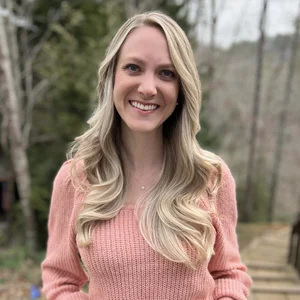
10 Pounds, No Tearing & Unmedicated: A Pelvic Floor Therapist's Surprising Birth Story

What if I told you that a pelvic floor therapist—someone who prepares women's bodies for birth professionally—delivered a 10-pound baby unmedicated with no tearing... and still says it was the hardest thing she's ever done?
Today's episode is incredibly special because Dr. Victoria Adeeb is returning to the podcast to share her powerful birth story. If you've been with me since the early days, you might remember episode 14 where Victoria taught us that pelvic floor dysfunction is NOT "just mom life." Now she's back on the other side of birth with a story that will encourage your heart, challenge your perspective on what makes a "successful" birth, and remind you that God's sovereignty is present in every contraction—whether your labor unfolds exactly as planned or completely differently.
If you're preparing for birth, wrestling with fear about the unknown, or simply need a fresh reminder that God walks with you through every moment of your journey, this conversation is for you.
🎧 Listen to the Episode
The Spiritual Journey to Motherhood
Victoria's story doesn't start with pregnancy—it starts with a profound spiritual wrestling.
Unlike many women who've always dreamed of becoming mothers, Victoria wasn't sure she wanted children at all. Her husband, on the other hand, knew from the beginning that fatherhood was a non-negotiable part of his calling. During premarital counseling, he lovingly but honestly told her: if she didn't want children, they shouldn't move forward with marriage.
That honest conversation launched Victoria into a season of deep prayer and soul-searching.
"What is my purpose?" she asked herself. "Why am I here?"
As she sought the Lord, the answer became clear: "I believe that my purpose on earth is to glorify God, and what better way to glorify God than to create more disciples for Him."
She also considered what she wanted her later years to look like—and realized she wanted to be surrounded by family. Once she truly surrendered the question to God, the decision became, as she puts it, "a no brainer."
When they were finally ready, God blessed them quickly with a healthy pregnancy—but the journey of surrender was only beginning.
💭 Reflection Question:
Have you taken time to spiritually prepare for motherhood, not just physically? What is God revealing to you about His purpose for this season?
Preparing Physically: The Pelvic Floor Therapist's Approach
As a pelvic floor therapist, Victoria had a significant head start. She'd been intentionally strengthening her pelvic floor and deep core for almost two years before she even became pregnant.
Her pregnancy was physically smooth—she stayed active, lifted weights, and even ran the Gate River Run at 22 weeks pregnant. But around 32 weeks, something shifted.
She was sore, achy, and not bouncing back as quickly from workouts. Like so many first-time moms, she convinced herself the baby was coming early and that it was time to "pump the brakes" on exercise.
Looking back, Victoria now coaches her clients differently: "Don't take your foot off the gas pedal. Maybe adjust accordingly, but you don't need to stop exercising at a certain point."
She focused on:
Different labor positions to keep labor progressing
Natural pain management techniques
Perineal massage to reduce tearing risk
Educating her husband through birth rehearsals with their doula
Victoria's physical preparation was thorough and evidence-based. But what she wasn't prepared for? The emotional and spiritual work required.
The Hardest Part: Emotional & Spiritual Preparation
Here's where Victoria's honesty becomes so refreshing.
Even though she's a professional who works with pregnant women every single day, the emotional and spiritual prep was the hardest part for her.
"I'm much more comfortable on the physical side of things," she admits. "When it came to really addressing what I needed to prepare for emotionally, that was really difficult for me, and I kind of avoided it until my doula gave me homework."
Her doula assigned her to: ✨ Reflect on her pre-motherhood life
✨ Acknowledge what she would miss or leave behind
✨ Grieve the closing of that chapter
✨ Choose Scripture that would give her strength and keep her focused on glorifying God
Victoria chose verses to anchor her heart during labor—passages her husband and doula could read over her when she needed reminding that God was walking alongside her through every contraction.
Why Spiritual Prep Felt Scary
"I think it was scary because I wasn't sure what God would reveal to me," Victoria shares. "On the physical side, I felt in control. I knew I'd reveal more strength, more mobility. But preparing spiritually meant addressing the fact that I'm not in control—that I have to trust, even when I'm scared."
Friend, if you've been avoiding the heart work because it feels too vulnerable or uncertain—you're not alone. But this is where the deepest transformation happens.
"The natural inclination when we go into the unknown is to fear it. But the faith aspect of it is a choice... knowing the Lord is good and whatever He has for me, whether it's blessing, breaking, or both—He's preparing me for it." – Natalie
The Waiting: When Baby Doesn't Come Early
Victoria was convinced her baby would come early.
He was measuring big at every ultrasound. She'd been given an alternate due date six days early. Both she and her husband were born 3–6 weeks early. At her 36-week appointment, she thought, "They could tell me I'm having this baby today."
But week after week: zero centimeters dilated. No effacement. No progress.
Her favorite provider went out of town. Her mother-in-law (a labor and delivery nurse) went out of town. And Victoria found herself at 40 weeks... then 40 weeks and five days... still pregnant.
This is where God met her in the waiting.
"God, what do you have for me in the waiting?" she prayed. "You're clearly making me wait for a reason. Maybe it's to show me I'm not in control. Maybe it's to show me I have to rely on You."
At her 40+5 appointment, she was maybe at one centimeter. Her provider scheduled an ultrasound for 41 weeks and an induction date for 42 weeks—but made it clear Victoria could decide what felt right as the time came closer.
During that appointment, Victoria received a membrane sweep.
That night at 9:30 PM, labor began.
Labor & Delivery: A Sacred, Hard-Won Journey
The Early Hours
Contractions started at 9:30 PM—and they were already less than five minutes apart. Within an hour, they were 2.5 minutes apart.
Victoria labored at home as long as possible with her doula, Leah. They had the lights dimmed, worship music playing, and her birth ball ready. She and her husband swayed together through contractions in what she describes as "a beautifully choreographed dance."
But things were progressing fast. They headed to the hospital around 11:30 PM.
The Discouragement of Triage
When they checked her in triage, Victoria's heart dropped.
She was still only one centimeter dilated.
"Did I come too early?" she worried. "Is this going to turn into a really long hospital labor with interventions I don't want?"
The nurse said they'd check her again in an hour. Still one centimeter. The nurse offered to let her go home or stay and check again in another hour.
Victoria chose to stay—and she's so glad she did, because an hour later she was at three centimeters and admitted.
Transition & Pushing
By 4 AM, she was in her hospital room. She labored upright the entire time—squatting, kneeling, sitting. The peanut ball became her best friend. Her doula and husband traded off giving her counter pressure and hip squeezes.
Around 5 AM, her birth photographer arrived. Victoria was deep in transition and didn't even acknowledge her. (She finally said hello after the baby was born!)
The nurse checked her: only four centimeters.
But Victoria knew something had shifted. "Check me again," she insisted.
Sure enough: 10 centimeters. Her body was already pushing.
"You better hurry up and get the doctor," she told the nurse, "because this baby's coming."
The Verse That Carried Her Through
Victoria pushed for 45 minutes on hands and knees. Her husband prayed over her the entire time. She knelt against the back of the hospital bed with her hands outstretched in prayer, asking God over and over: "Please, let this be the last contraction."
The verse that anchored her?
"But those who hope in the Lord will renew their strength. They will soar on wings like eagles. They will run and not grow weary. They will walk and not faint."
– Isaiah 40:31 (ESV)
"I was very weary at that point," she says. "But that strength came from the Lord. The Holy Spirit was present in that room—you could feel it, you could sense it."
The Beautiful, Hard Truth: 10 Pounds, 2 Ounces
At 7:25 AM, after less than 10 hours of labor, Victoria's son entered the world.
10 pounds, 2 ounces.
The entire room erupted in cheers when the number popped up on the scale.
And here's the detail that still makes me tear up: Victoria had been given an alternate due date of 7/26—and her baby was born at 7:25 AM on what happened to be her and her husband's dating anniversary and the day he proposed.
"It felt like a cute little wink from God," she says. "Like, 'I got you. I had you this whole time.'"
No interventions. No IV. No tearing. No stitches.
But here's what Victoria wants you to know:
"Natural labor was so hard. It was SO hard."
She's honest that if her labor had been any longer, she would have asked for an epidural. And for future births? She might choose one from the start.
"Whatever intervention a woman chooses is 100% her choice," Victoria says. "You just don't know what place you're gonna get to during that birth process. There's nothing you can do to make the Father displeased with you."
Postpartum Reality: When the Professional Becomes the Patient
Victoria's postpartum story is a powerful reminder that even the experts don't do it perfectly.
The 5-5-5 Rule She Didn't Follow
As a pelvic floor therapist, Victoria teaches her patients the 5-5-5 rule:
5 days in the bed
5 days on the bed
5 days around the bed
Did she follow it? Nope.
"I was my own worst patient," she admits. "I felt so good postpartum that I just went about business as usual. I was doing dishes, hosting family, walking around. To me, being home was resting."
But by week two, symptoms started appearing:
Heaviness in the pelvic region
Urinary leakage when sneezing
Pelvic discomfort with movement
She had to go back and truly rest—starting from zero as if she were freshly postpartum.
The Vulnerability of Sharing Symptoms
Victoria is incredibly brave to share this: even after a "dream birth" with no tearing, she's experiencing:
Grade 2 prolapse (she had grade 1 pre-pregnancy)
Occasional urinary leakage
Pelvic heaviness with certain movements
Occasional pain with intercourse
"Your body is still healing and recovering," she emphasizes. "It is normal to need time. There is no substitute for time, even if you're doing the appropriate things."
Breastfeeding Struggles
Breastfeeding has also been challenging. Her son has tongue tie, a weak latch, and potential jaw tension. Despite working with an incredible lactation consultant, it's been a journey of pumping, persistence, and releasing the pressure to have it look a certain way.
"My plan was easy, breezy, natural breastfeeding," Victoria says. "That has not been my story, and it's okay."
Where the Ideal Is Unrealized, Grace Abounds
One of my favorite quotes from this conversation came when I shared something my pastor says:
"Where the ideal is unrealized, grace abounds."
Friend, can we just sit with that for a moment?
Whether it's birth, postpartum recovery, breastfeeding, or motherhood in general—you don't have to do it perfectly to be faithful.
Victoria's story is a mixed bag of blessing and breaking. On paper, it looks like a dream birth. In reality, it required deep surrender, hard physical work, and ongoing grace in the weeks and months that followed.
But through it all? God's hand was sovereign over every detail.
Down to the minute her son was born. Down to the ounce he weighed. Down to the way her body healed and the lessons she's learning in the mess of early motherhood.
📖 Scripture for Your Heart
"But those who hope in the Lord will renew their strength. They will soar on wings like eagles. They will run and not grow weary. They will walk and not faint."
– Isaiah 40:31 (ESV)
🙏 A Prayer for You on Your Journey
Heavenly Father,
Thank You for the mama reading this right now. Thank You that You see her—in her preparation, in her fear, in her hope, and in her surrender.
I pray that as she walks toward her birth day, she would feel Your presence in every contraction. That she would know You are not distant or disappointed, but walking right beside her, giving her strength she didn't know she had.
Help her release control. Help her trust Your timing, Your plan, and Your goodness—even when things don't unfold the way she imagined.
Remind her that there is no "perfect" birth performance that earns Your approval. You are already pleased with her. You have already chosen her to be this baby's mama.
And when the ideal is unrealized—when things are hard or messy or different than she planned—let her feel Your grace abounding in those moments.
We trust You, Lord. We trust that You are good.
In Jesus' name, Amen.
Final Thoughts: The Caterpillar & The Butterfly
I want to leave you with this image the Lord gave me during our conversation:
When you give birth, it's like being a caterpillar that transforms into a butterfly.
The butterfly can never turn back into a caterpillar. And the caterpillar does things, stays in places, and has activities that are completely different from a butterfly.
We often have this mentality of, "I just want to go back to being a caterpillar. I just want things to be the way they were."
But friend, that's not what the Lord has for you.
He has called you to be a butterfly. Being a mama is the most hard, most beautiful, most rewarding, most challenging thing you will ever experience. And that transformation is unlike anything else.
Things are different now. But different doesn't mean lesser. And time will slowly bring you back to a place where you can enjoy some of the things you once did—just in a new way, with new purpose.
You're not meant to go backward. You're meant to unfold your wings and soar.
📎Resources & Links Mentioned
✨ Christian Mama Birth Prep Library - Free birth prep tools, worship playlists & more
💕 Work with Me 1:1 – Virtual Doula Support & Schedule a Private Coaching Call
✝️ Online Christian Childbirth Education - Explore my complete birth preparation self-paced course
🎴 NEW Christian Birth Affirmation Cards: You can now purchase them here
❤️🩹 Better Women’s Health - Visit Dr.Victoria Adeeb’s Practice
📣 Let’s Stay Connected
If this episode encouraged you:
Hit subscribe and leave a review on Apple Podcasts or Spotify.
Text a friend and share the show with a fellow mama.
Grab your free birth prep tools at the Christian Mama Birth Prep Library.

Meet Your Host —
Natalie is a certified birth doula and childbirth educator in Jacksonville, FL. She's trained through DONA International, certified as a Body Ready Method Pro, and an advanced VBAC doula. Through Faith Over Fear Birth, she equips Christian women to experience peaceful, faith-filled births through both virtual and in-person support.
🔗 More You Might Love
📄 Full Episode Transcript
Natalie: Hey friend, and welcome back to the podcast. I am so excited for today's episode because we have something really special—our very first returning guest. If you've been with me since the early days, you might remember episode 14 where we talked about leaking, pelvic pain, and why "that's just mom life" is a lie we need to stop believing. Dr. Victoria Adeeb joined me for that conversation to share her incredible expertise as a pelvic floor therapist, and at the time she was pregnant herself. Now she's back, but this time she's on the other side of birth, and I cannot wait for you to hear her story.
What I love about Victoria is that she doesn't just bring the professional knowledge—she brings her whole heart to this work. And now she's here to share how she prepared for what she calls her dream birth. And just to tease her story a bit, her baby was over 10 pounds and she didn't even tear. Now she's here to tell her story and how she's navigating postpartum healing. Victoria, welcome back. I'm so glad you're here.
Victoria: I'm so excited to be back.
Natalie: Yes, me too. So let's actually start from the very beginning of your birth journey. What was it like for you guys even initially becoming pregnant?
Victoria: Our journey to becoming pregnant really was very spiritual for myself. My husband always knew that he wanted to be a dad, and I just did not fall in that category. I was very unsure of whether or not I wanted to have children. He told me in premarital counseling that I needed to decide if I wanted kids because that was so important to him that he didn't think we should move forward with getting married if I didn't want children. So I did a lot of soul searching, a lot of praying, and really, for me, what it ultimately came down to was: Why am I here? What is my purpose?
I believe that my purpose on earth is to glorify God, and what better way to glorify God than to create more disciples for him. I also thought about what I want my later years in life to look like when I'm older and towards the end of life—what do I want? And I want to be surrounded by family. So having kids ended up being a no-brainer after I really thought about it and spent some time with God. The physical side for us was easy. We really had no problems getting pregnant. Once we finally came to that decision, we took our time coming to that decision. My husband and I have been together for eight years, so we really enjoyed each other for a long time.
And then when we decided we were ready, we were just extremely blessed that God was ready too. And yeah, we got pregnant—smooth, easy, no problems there. So it was a very spiritual journey, and I really just feel like I learned a lot about myself in that decision-making process. And I continued to learn about myself while I was pregnant and now being a mom.
Natalie: That's so beautiful. I do feel like the moment you have that desire in your heart to become a parent, it really does change you from that point on. And so the fact that it was actually your husband that had that desire first and then later, as you just the more you sought the Lord in making that decision or seeking his desire for your life and all that, that's so beautiful. I feel like that's kind of a rare take on that. But yeah, so beautiful because it is—I think in some ways you were counting the cost of what it looks like to become a mom. Because it's not this thing that you can just take on lightly.
Before we hopped on and pressed record, we were talking about how much it just really changes everything when you become a parent. Not that that's your primary role and that should be the most important identifier—we are absolutely a daughter of the King, that is our number one identity—but the role of a mother changes so much about who we are, and it is a thing to not take on lightly. So that's really special that that's part of your story. I would love to just hear more about how your pregnancy was overall, how did you prepare emotionally, spiritually, physically, practically—all the things.
Victoria: Yeah, yeah. So my preparation process started before I was even pregnant. I took a lot of time to consider the implications of becoming a mom and the implications of pregnancy physically as well as emotionally and just how it changed my life. I would say I've been a pelvic floor therapist for almost three years now, and I started preparing my pelvic floor and my deep core as soon as I started learning about pelvic floor therapy. I had a solid year and a half, almost two years of foundation on pelvic floor and deep core work before I even became pregnant.
That being said, pregnancy was a breeze physically. I had some tailbone pain for a little while during pregnancy. I did all the things I needed to treat it with stretching, with manual therapy. When I was good about doing my exercises, the tailbone pain went away. When I was bad about doing my exercises, it was there. Really, I stayed very active throughout pregnancy. I was strength training. I actually ran the Gate River Run at 22 weeks pregnant or something like that. Physically, it was just beautiful. It was a breeze.
Towards the end of my pregnancy, I was probably about 32 weeks pregnant and I had convinced myself that this baby was coming early, as so many first-time moms like to hope for. I just remember vividly, I had gone to the gym multiple times that week. I had probably done three or four workouts that week already, and I was sore and I was achy and I just was not bouncing back as quickly. And I thought to myself, "Hmm, I guess it's just about that time where I need to start slowing down and I need to do less and focus on mobility, focus on pelvic opening, labor and birth prep."
I will say I think I pumped the brakes a little too much now that I can look back on it, and I have adjusted my treatment approach for my clients now that I have personal experience. It's one thing to have the clinical experience and the research and the evidence-based treatment plan, and then now to add my personal experience into that—that is great. So that's one thing that I learned at the end of pregnancy: don't take your foot off the gas pedal. Maybe adjust accordingly, but you don't need to stop exercising at a certain point. A lot of people say to me, "Well, when should I stop running or when should I stop lifting?" And the answer is, I don't know—when your body tells you to. And maybe it's not stopping, maybe it's just changing that activity a little bit.
But yeah, then I transitioned into birth prep. I focused a lot on different labor positions—what positions to use when to keep labor progressing. I focused a lot on natural pain management techniques because my goal was to go unmedicated. I focused on perineal massage, which is one of the very popular treatments to reduce the risk of severe tearing during vaginal delivery. I spent a ton of time educating my partner. My husband's very sweet, but he is not the best when it comes to medical stuff, and so having a hospital birth I knew would be difficult for him to experience. But I think being in the hospital made him even more nervous.
And so that's where having my doula came into a huge role, because although I am a professional in the women's health space, it sometimes is received better coming from a third party. And you know, it's safe to ask questions without feeling dumb or feeling like, "Oh, you know, she's gonna expect me to already know this." And so we had several birth rehearsals with our doula. We reviewed a lot of different options that the hospital would offer us and what our plan was going in if those options were given.
And I didn't start preparing emotionally and spiritually until my doula addressed it with me. I think, me being a physical therapist, I'm much more comfortable on the physical side of things—doing the stretches, doing the deep core exercises, doing the perineal massage. And when it came to really addressing what do I need to prepare myself for emotionally, that was really difficult for me, and I think I had kind of avoided it until my doula gave me homework and was like, "Victoria, this is what you need to do to prepare yourself emotionally."
One of those things was to just kind of reflect on my time pre-motherhood, acknowledge the things I was gonna maybe miss or the things that I was choosing to leave behind into my pre-motherhood era, almost grieve those things in a way and be okay with the fact that that door was closing. And then emotionally, I went through scripture. I chose a couple things that I felt would give me strength when I needed it, a couple things that I felt would keep me focused on glorifying God during this difficult time and knowing that he was walking alongside me as I was going through this.
And I was very grateful that I had a faith-based doula to help guide me through that. And she helped me write a few things down, and then during the birth process, it was great that my husband had those to refer to, that he could read scripture over me during labor, that she was reading things for me, and that we were just kind of all on the same page of what our goal was for this birth. And our goal was to stay grounded in the fact that God was walking alongside me through every contraction and stay grounded in the fact that this is a beautiful thing that I'm getting to experience and that it's because God chose me to be this baby's mom.
So yeah, preparing spiritually was difficult for me, honestly. And that's coming from someone who's very comfortable with prayer and very comfortable with reading scripture, you know, comfortable with going to church every week. But I think it was scary because I wasn't sure what God would reveal to me. So it was easier for me to just know what I was gonna reveal to myself through the physical preparation. I was gonna reveal that I had more strength, that I had more mobility, that I could prevent things. And I think it made me feel a little bit in control of the situation.
Whereas when preparing spiritually, I think addressing the fact that you're not in control and that you have to trust and that there's gonna be moments where you're scared—you're just gonna have to trust that God is walking beside you through that moment. That was a challenge for me, but it just taught me so much about myself, taught me about God and who he is and that he's good and that he has good plans. You know, even when birth got hard, because it definitely had its moments where it got hard. But yeah, that was kind of birth prep in a nutshell.
Natalie: That is fantastic, and I love your honesty of like, physical side of it—nailed it, got it, I had it in the bag. But preparing emotionally and spiritually, there was even an acknowledgement of "I am not prepared for this aspect," which I think is very, very crucial to actually preparing for birth. I don't think that you can actually be fully prepared for birth if you are not considering the emotional cost that it will take. Which, I wanted to point out something that you said that is so wise to do, and it is to kind of start to grieve the fact that your life is going to change.
In ways where just going to run an errand, like going grocery shopping or grabbing a dinner with a friend or something like that, those things become these monumental tasks once you have a child. I did not emotionally prepare in that way with my first, and I remember sitting there in the middle of the night and looking back through Facebook memories. It would be like, "This day, however many years ago you were on this trip or you were doing this with your friends or whatever." And I remember grieving, being like, "Will I ever get to experience these things again? I feel like I am a shell of myself. All I do all day long is nurse this human." And so there was like this emotional piece that I definitely needed more preparing for that I didn't even know that I needed. And so thank you for pointing that out because I think that's something really important to bring to mind as you consider emotionally preparing.
And then the spiritual aspect—yeah, I think if we're used to being in constant contact with the Lord, prayer, worship, reading his word, talking about him with our friends, like all the things, but then we kind of neglect like, "Okay, but how does this actually pertain to what I'm about to walk into?" Because birth is a very spiritual experience, whether you're ready for it or not. And that's why I think my heart is so much to prepare in faith over fear, because the natural inclination when we go into the unknown is to fear it because we don't know what's ahead. So we don't know if we have what it takes.
But the faith aspect of it is a choice, and it's not, you know, counting the cost of "Okay, do I have what it takes?" But it's knowing I know the Lord is good and whatever he has for me, whether it's blessing, breaking, or both—because it's usually both—that whatever he has prepared for me, he's preparing me for. And in faith, I'm gonna trust that he's gonna get me through it. Not in my own strength, but like, he is going to be my strength in it. So thank you for pointing that out. I think that's a crucial piece to preparing for this labor and birth experience.
So speaking of which, let's go into your birth story. Share about the time that you went into labor, how far along were you, and just roll right into that experience.
Victoria: Yes. So I had convinced myself that I was definitely gonna have this baby early, and there were so many factors that I kind of relied on to predict that. He was a big baby all along. Every time we had growth scans or anything like that, he was always measuring big. I was even given an alternate due date that was six days early based on early ovulation and his size and everything. My husband and I were both born three to six weeks early, the two of us. And I was like, "That's it. He's just gonna be here early."
I remember going into my 36-week appointment being like, "They could tell me I'm having this baby today." And it wasn't. And I said, "Okay, that's fine." And every week—nope, you're zero centimeters dilated, your cervix is not effaced at all. There's nothing, no progress, no signs of progress. And I remember debating whether or not I wanted them to do a cervix check at these appointments because I was like, "Dang, am I just gonna get in my head about it if they say no, there's no progress?" But being a clinician, I was like, "Give me the data. I will grapple with that data in whatever way I need to, but give me the data."
So at my 40-week appointment, they were like, "Still nothing." And my favorite provider was going out of town. My mother-in-law, who's a labor and delivery nurse at Beaches Baptist where I delivered, she was going out of town. Everyone was like, "Where is this baby?" So that is where I kind of got really discouraged and really truly started to surrender myself to the Lord because I was like, "God, what do you have for me in the waiting? You're clearly making me wait for a reason. Maybe it's to show me that I'm not in control of the situation. Maybe it's to show me what I don't know, to show me that I have to rely on you." But that was a very difficult kind of two or three weeks for me.
And I went in for an appointment at 40 weeks and five days. The doctor said, "Well, you're maybe at a one." I said, "Okay, well that's progress. I mean, I'm not gonna get my hopes up, but that's progress." And I will say my providers were amazing. I was going past my due date. I have a big baby, and I do think that some people have the experience in the hospital system of feeling pressured into an induction or feeling pressured into interventions at this point. That was not my experience at all, and I'm so grateful for that because although I do feel confident that I would've been able to advocate for myself, nobody ever suggested an induction.
At that 40-week-and-five-days appointment, they did say, "Okay, at 41 weeks, in two days, we're gonna have you go to the hospital. We're gonna do an ultrasound just to make sure everything's okay, that baby is safe to stay in there, and we will schedule you an induction date for 42 weeks pregnant." And I said, "All right, I think that's fair. You're not rushing me to do it right now, and we'll get it on the calendar." And she even said, "You know, as that date gets closer, you can decide what you wanna do."
So during that appointment, I did get a membrane sweep, and I went into labor that night. So it worked. It was fine. And it was about 9:30 p.m. We had had dinner, we were kind of wrapping up for the night, we were getting in bed, we were gonna watch a movie, and I started feeling contractions. And I had not had any false labor really before that. So when I started feeling these contractions, I told my husband, "Hey, I'm having contractions. They're happening pretty consistently. Maybe we should start timing these."
He gets out his little contraction timer app. He starts timing them, and they're already less than five minutes apart. I said, "Okay, well, let's just hang out, see what happens." Then they got down to four minutes apart, and I said, "Okay, I am gonna take a hot shower, see if these contractions space out." He texted my doula and said, "Just so you know, here's where we're at. We're gonna see if they continue." I get out of the shower, and the contractions are now three and a half minutes apart, clearly progressing. He told the doula, "All right, go ahead and come over."
So my doula, Leah, came over. She was wonderful. The plan was to labor at home as long as possible. We had the lights dim, we had music going. I had my birth ball. I had all my different movements that I wanted to do with my husband, and it almost felt like a beautifully choreographed dance where we were just kind of swaying together and enjoying it. But these contractions were coming quickly. We looked down and the contractions were two and a half minutes apart. And I asked my doula, I was like, "Should we go to the hospital?" They weren't that intense yet, but they were the most intense contractions I had ever felt, but they were two and a half minutes apart. And she said, "It's totally up to you. I mean, the hospital's close by. They are very close together. Typically, I would say yes, but you seem to be doing okay." I said, "Let's just go because I don't know. I've never felt labor before, and they were ramping up in intensity."
So we get to the hospital about 11:30. So all this happened in two hours. We get to the hospital, 11:30, they check us into triage. I'm still at one centimeter dilated, and my heart dropped when they told me I was one centimeter. And I said, "Oh shoot, did I come too early?" That was one of my fears, getting to the hospital too early. Then you're in labor for a really, really long time at the hospital, and that's when people have told me they'll start recommending different interventions. My goal was to just be unmedicated, all natural, as much as possible.
So they said, "Since you're only one centimeter, we're just gonna wait and check you again in another hour. So if you wanna walk the halls and do things like that..." At this point, contractions had gotten intense, like difficult to breathe through them, walking up and down the halls, stopping in my tracks when a contraction comes on. That's an hour. I get checked again—still at one centimeter. And at that point, the nurse said, "Well, you can go home if you want to, or you can stay and we can check you again in another hour. It's up to you."
I asked her, "Well, how would I know to come back? My contractions are already really intense and they're already two and a half minutes apart, two minutes apart. How do I know when it's time to come back?" She said, "Well, your water's already broken," which I never felt my water break. If I had a slow trickle at some point, I never felt my water break. But when they checked me, they said that my water had broken. She was like, "Yeah, I mean, I guess just when things get more intense." And I said, "Honestly, things are already really intense. I'm gonna just stay, just because I don't know when I would come back."
Well, I'm glad I did because an hour later I was at a three and they admitted me. And I was in my hospital room, checked in, ready to go by about four o'clock in the morning. And my doula got to come back with me. We got all set up. It was a long night for sure. I labored overnight the whole time. Most of my labor positions were upright the whole time, which I wanted anyways because I know that kind of keeps things progressing, keeps baby engaging in the pelvis. The peanut ball was my best friend. I think I was holding onto that peanut ball for dear life. My doula and my husband were switching off with counter pressure, hip squeezes. I had a TENS unit on my back at one point, and we were doing all the things.
And I tried to lay down to get some rest at one point because it was an overnight labor. And when I laid down, the pain was so severe that I actually threw up. I could not lay down at all. I was squatting, kneeling, and sitting the whole time, which is fine because that's, I think, what helps labor go so fast. But around five in the morning, my birth photographer arrived. I was deep in transition at that point, and I don't think I even acknowledged her when she walked in the room. And I think after the baby was born and everything was said and done, I looked over at her and I went, "Hi." So I finally said hello to her after the baby was born.
But I was deep in transition, and you know, they had checked me and I was only at a four, like a few minutes before that. I remember telling the nurse, "Check me again." And she was like, "Well, we just checked you and, you know, you're progressing but not that fast." I said, "No, check me again. I'm telling you something has changed." And sure enough, I was 10 centimeters. I was like, "I'm ready to push. I feel my body pushing. I can't stop it." And she said, "Okay, well don't push yet. I need to go get the doctor." I said, "Well, you better hurry up because this baby's coming."
So I pushed for about 45 minutes. I pushed on hands and knees with the hospital bed inclined. And my husband prayed over me the entire time I was pushing. I was kneeling against the back of the bed just holding my hands out in prayer, just asking God to make this the last contraction this time. And every time it wasn't. But yeah, I really did tap into a different strength at that point, which, you know, I think any mom will agree, whether you are a believer or not, there is a strength that is like outside of yourself that comes at that point of your birth where you just find that next level and you do what it takes to meet your baby.
And the verse that I loved during that time of actually pushing and that time of feeling just so exhausted and so weak after being up all night long was Isaiah 40:31. And it says, "But those who hope in the Lord will renew their strength. They will soar on wings like eagles. They will run and not grow weary. They will walk and not faint." And truly, I was very weary at that point. But yeah, I mean, that strength I know comes from the Lord, and I know comes from the Holy Spirit being present in that room. And you could feel it and you could sense it.
And then he was here, and that was really surreal because it just felt like, "Oh my gosh, please make this the last contraction. Please. Is he here?" I pushed for about 45 minutes, and he came into this world at 10 pounds and two ounces. He was a big boy. And I just remember everyone was waiting to see the scale, waiting for that number to pop up because, again, he had just been measuring big my whole pregnancy. And I'm gonna be honest, my belly was huge at the end. And we were like, "Oh my goodness, how big is this baby gonna be?"
And so when we saw that 10 pounds, two ounces pop up on the screen, I think the whole room started cheering. But it was incredible. And, you know, he was born with chunky cheeks and he still has chunky cheeks. And who doesn't love a chunky baby? There's some people you say, "Yeah, I had a 10-pound baby," and they almost are like, "Whoa," like it's a bad thing. But it was glorious, it was beautiful, and I had no interventions whatsoever. Did not have a single IV or anything. Had no tears, no stitches or anything. And yeah, he was perfect and he was beautiful.
But that being said, natural labor was so hard. It was so hard. And so I started labor at 9:30 p.m. and he was born at 7:30 a.m.-ish. Well, actually, to be exact, he was born at 7:25 a.m. And the reason I say that is because I was so curious what God was trying to teach me in the waiting. And his alternate due date that had been given to me was 7/26. So I was like, "Oh, how cool would it be if he was born on 7/25?" Because that is me and my husband's anniversary from when we were dating, and it's also the day he proposed to me. And so when they said he was born at 7:25 a.m., it just felt like a cute little wink from God. Like, "I got you. I got you."
And then he was born 10 pounds, two ounces. It was just so surreal knowing that I had trusted in what God had for me, that he just showed me so beautifully, like, "Hey, I had you this whole time." And yeah, it's just so cool knowing that even when things don't go the way that you expected them to or the way you hoped, he's had it in his hands the whole time. But yeah, I mean it was a hard labor for sure. It was a short labor—it was fast, you know, less than 10 hours.
And I will say, my moms who come to me saying, "I'm planning on not getting an epidural. I don't want to, but if it gets to a certain point..." If there's one thing I've learned, it is that everyone's birth journey is unique and different, and whatever intervention someone does or does not choose to have is absolutely 100% their choice. Because there were several moments during that labor where I was like, "I want an epidural." And my doula had discussed with me ahead of time and said, "If you reach that point, what do you want me to say?" I said, "If I reach that point where I start asking for an epidural, convince me otherwise, like keep me on track," whereas others kind of say, "Hey, if I start asking for an epidural, let's actually consider that."
I definitely learned that any intervention that a woman chooses during her birth is not to be judged and is 100% her choice because you just don't know what place you're gonna get to during that birth process, and you just have to trust that whatever happens, God is gonna be beside you regardless. There's nothing that you can do to make the Father displeased with you. If you feel that changing your birth plan is gonna make anybody disappointed or displeased with you, I think just relying on that truth that the Lord is pleased with you and that he has your story already written and has your story in his hands will hopefully bring you peace in that decision-making process. Because I will still say to this day, had my labor been any longer, I would've ended up with the epidural. Honestly, for subsequent children, I might just choose an epidural because it was hard. It was really hard.
And so that's the beauty of what I get to do and what you get to do—you get to walk with women through all these different choices, and you get to see kind of how things unfold for them, and you get to support them through a vast range of choices and a vast range of options and a vast range of experiences. So I think it's easy to look at the birth story—10-pound baby, unmedicated, no tears—and just be like, "Oh, wow, what a breeze." It was not a breeze. It was so much work. It was so hard. And I'm very grateful for it and I'm grateful that I worked really hard at it. But yeah, I just think it gave me a lot of respect for all moms who've given birth—vaginally, cesarean, you know, home, hospital—because it can be scary to make those choices.
Natalie: Yeah, I think that's one of those misnomers that if you hear someone went unmedicated and no tearing and all those things, that that means that her birth was really easy. And my last birth was a home birth. I didn't tear this time, and it was extremely difficult. But then there's also, like you're pointing to, the circumstances outside of your control that also allowed you to have that type of birth experience. My labors are also not very long. My first was 12 hours, my second was nine hours. Okay. If I had been laboring for 24, 48 hours, which I do have clients that labor that long, I don't think I could. Thinking in my mind what labor feels like for me and experiencing that for that long period of time, not sleeping, all the things, I don't think that I would be able to have the natural birth experiences that I've had.
And so there's a couple things I wanna point out about that. First, I think there is such a lie that our value is measured by the experience we end up having—that if my goal was to have unmedicated, that I either accomplished it and so I have pride because of that, or I planned to have unmedicated, I did not have unmedicated, and you just crush yourself because you didn't accomplish what you'd set out to do. But that is like you're aiming for the wrong thing. And it's beautiful that you prepared in the ways that you did because it did afford you the ability to have the strength, the stamina, the mental fortitude, all of that to have the experience that you had.
But again, there were circumstances outside of that that also allowed that to happen. And ultimately, it was the Lord's will for the birth to unfold that way. So yeah, if you're listening to this and you have an upcoming birth, I want you to hold that plan that you have in your mind for the way your birth is gonna go so loosely. Not as an excuse to not prepare, because I think faithful stewardship is the key to preparing in the right way with the right heart posture, but to ultimately give the Lord the outcome. And it's up to him what he allows your labor to look like and what story you get to tell because he will be glorified in whatever story unfolds. But to hold yourself on the hook for the things that are out of your control is setting you up for failure. And so I love that you acknowledge that part of your story, especially because you do interact with so many women that are in a life stage of preparing for their birth physically and all the other things.
And I see it time and time again as a doula, as I'm preparing mamas physically, emotionally, spiritually for this journey. There is so much heart work that we need to prepare for when we touched on this at the top. But yeah, thank you for sharing that story. That's so beautiful. Can you share more about how your postpartum time went, how nursing went, how you physically had been recovering? Because you're four months postpartum now. What's that journey been like?
Victoria: Postpartum has been ups and downs, honestly. I mean, there's good things and bad things that I've experienced. Breastfeeding has been a challenge. Breastfeeding is one of those things that, again, I have experienced a new level of grace and understanding for moms who choose not to or wean early or pump and do a bottle or, you know, a multitude of choices. Again, because breastfeeding has not been an easy journey for me. My son has tongue tie. He has a weak latch. He has, we believe, potentially some jaw tension because he doesn't open wide. I have some anatomical stuff that makes it difficult for him to latch, and so it has been quite the journey. And I have the world's best lactation consultant on my side. She has been with me from before he was born. She came to my house four days postpartum. She's been in my house multiple times, and she's been incredible. But, you know, sometimes it's just challenging. It's just difficult.
I'm very blessed that I've had a good breast milk supply this whole time. So I've been able to pump, and that has been—it's been reassuring and it's also allowed me to take some of the pressure off to perform. Because very similar to what you're saying with birth, sometimes you have a plan and there's like pride if that plan goes the way you want it to, and shame if it doesn't. And my plan was just this easy, breezy, natural breastfeeding where you can just pop 'em on a boob and keep going. And that has not been my story, and it's okay. And I am working very hard to continue breastfeeding at this point. And I'm hoping that I will be able to continue my breastfeeding journey for his entire first year of life. We'll see, we'll see what things hold for me and for him.
As far as my physical recovery postpartum, I did my number one rule that I give my patients—my number one rule is the 5-5-5 rule to just rest five days in the bed, five days on the bed, five days around the bed. I didn't do it. I was my own worst patient in early postpartum. I think it's so hard to make yourself do it, and I think the problem for me is I did not have a clear definition of what rest means. And for me, I'm very active. I love working out. I own a business. I'm kind of an on-the-go person. I've always had multiple jobs, multiple hobbies, multiple exercise routines going at the same time. And so to me, being home was resting, even if I was doing the dishes or even if I was walking around with my family who was visiting. I did not rest appropriately. And that was just get horizontal, lay your butt down, stop moving for a couple of days.
And I think part of that was that I felt very good postpartum. I, again, didn't have tearing, didn't have the epidural, so I kind of just went about business as usual. And the first two weeks, I felt fine. I felt great. And it was after that that I started experiencing some symptoms of heaviness in the pelvic region, some urinary leakage, things like that that are so common. And so I did actually have to go back and rest and start from zero, basically, as though I was freshly postpartum.
My advice would be to have very clear expectations of yourself for postpartum of what rest looks like. Set yourself up for success with your support system when it comes to rest. Set appropriate boundaries with your support system. If you have a family who's very involved and very hands-on, if that doesn't feel restful for you, if that feels like work for you, set those boundaries early on. I had family there and I was basically in hostess mode from day three postpartum.
So I did have some pelvic floor dysfunction, and I still do. I had grade one prolapse before I was ever even pregnant. I currently have grade two prolapse after vaginal birth. I have urinary leakage when I sneeze. I have some pelvic heaviness when I try to walk or squat or do too much too soon. I have occasional pain with intercourse. And I say all this—I'm very vulnerable about all this—because I had a beautiful birth and, you know, quote-unquote dream birth and no issues during birth, but your body's still healing and your body's still recovering. It is normal to need time. I'm not saying these symptoms are normal because that comes with its own caveat of it's normal, but we can do stuff about it. But there is no substitute for time, even if you're doing the appropriate things.
And I think that has been a beautiful experience for me to just slow down, give myself some grace, and I do my pelvic floor exercises and I am back in the gym even with these symptoms. Because I love exercise and I love being active, and that is what's important for my mental health as well as my physical health to be able to move my body. Learning how to do those things safely and effectively without creating more problems is the key, because you wanna be able to get back to your life and you wanna be able to do the things that make you feel good, especially in the postpartum period where you do lose a piece of yourself. And getting back to feeling like yourself is so important and finding a new sense of normalcy is important, and including self-care and physical wellbeing is a huge piece of that. So yeah, postpartum has been up and down for sure, but I'm staying moving, staying active. I'm managing symptoms and I'm improving every week.
Natalie: Well, and the other thing that I'm like over here just like, I'm so glad you're sharing this, is just that reality of, "Hey, I am a professional in this space and I didn't do it perfectly. And there were lessons in all of this for me."
Victoria: Mm-hmm.
Natalie: After Daniel was born, my second, I was up in atom, and I tell my clients the 5-5-5 rule—the five days in the bed, five days around the bed, five days around the house. Did I follow that? Absolutely not. Did I bleed for like twice the time you're supposed to? Yes, because I overdid it because I did not realize the discipline it took to rest. And many of us are like that. Many of us find it is harder to rest than to let someone else do it, to delegate it, to ask for help. That's a big one for me.
And so this time as we're preparing for Isaac's birth, I'm like, "Hey, Mom, are you able to keep Ellie and Daniel that first night with Isaac? Can you watch the kids?" Because I do not wanna have a repeat of Brian and I waking up that next morning in a literal haze because we labored all night. I was like, "We're not doing that." So I don't know what time he's gonna be born, but just like asking for help. Because assume that you will automatically need more help than you think you will.
And it does—it takes more discipline, it takes more humility to rest than it does to just try and do it yourself, especially if you do feel good. Like I felt good after my home birth. And so, yeah, I just kind of overdid it. So thank you for pointing that out because I think that's reassuring. It's encouraging to hear someone else say that, like to me, but then also to just have other mamas hear that you're saying that even as a professional, that we don't all get it right. Even if we know cognitively the knowledge, the right thing to do, that actually walking that out, practicing that, implementing that in real life, there's a disconnect a lot of the time.
My pastor says this all the time, but he says, "Where the ideal is unrealized, grace abounds." And that has been a really beautiful thing that the Lord keeps kind of bringing to memory, not just in regards to birth, but parenting, being a wife, being a friend, being a sister, being a mom, like all the things. And I feel like that's a really beautiful message for your story as well, that, you know, where the ideal wasn't realized, grace abounds, even though there were so many things that, on paper, went exactly the way you wanted. But in other ways, it was very different. And so there's usually a mixed bag of blessing and breaking in your journey. But just being able to kind of see all of it, just like bird's-eye view, seeing all of it—God had his hand, he was sovereign over every single detail down to the minute he was born, to the day he was born. Just all the things he has it. And what a beautiful thing that we get to just rest in that instead of feeling like the world is literally on my shoulders and I need to have all of this figured out because it's impossible. So I love that you pointed out so much of that. It is really encouraging to hear that.
Well, my last question for you is just, again, kind of reflecting back on this whole experience, what was the biggest lesson that the Lord showed you?
Victoria: I think the biggest lesson that God has shown me is his sovereignty. We really try to be sovereign over our own lives sometimes. Pregnancy and birth are things that you can't control. There are factors outside of your control, and learning that surrender and trusting that he's not only sovereign, but he's sovereign and he's good, and that regardless of what he has in the moment, his plans are good. And that was another one of the verses that just, I had my team keep speaking over me because I needed help believing it in the moment.
Being able to reflect back and see it, you can see it in the details that his plan was to prosper me the whole time. And it still is. I'm still healing, I'm still recovering, and there are days that are difficult emotionally and balancing a new life and a new version of myself as a working mom and as a wife who also has to take care of a baby and as a friend who doesn't have the time to pour into her friends the way she used to. He's still good and sovereign in all of those moments and in the journey ahead as well.
Natalie: That's beautiful. And the Lord just kind of gave me this kind of picture in my mind, but that when you give birth, it's like being a caterpillar that you then transform into a butterfly. And the butterfly can never turn back into a caterpillar. And the caterpillar does things—it stays in places and it has activities that are different than a butterfly. We have that mentality of, "Oh, I just wanna go back to being a caterpillar. I just wanna go back to the way things were." But that's not what the Lord has for you. The Lord has for you to be a butterfly. Being a mama is the most hard, most beautiful, most rewarding, most challenging thing you will ever experience. And the journey, that transformation is unlike anything else.
And so just accepting that things are different. Not that they will forever be, you know, so different that you can't experience some of the things you did before, but that it is just different. And time will slowly bring you back to a place of being able to enjoy things that you once did that right in this moment are not really a possibility. And that's okay. That's not forever either. But Victoria, thank you so much for coming on and sharing your story. It is so incredibly powerful, so needed, and wow, what a beautiful way to just see the Lord's sovereignty and his goodness in your story. So thank you so, so much for coming on.
Victoria: Thanks, Natalie. It's always my pleasure. So happy to be here.