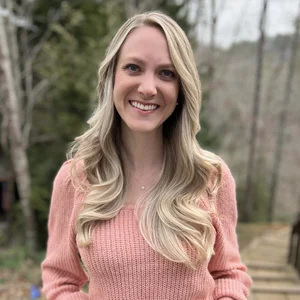
God is in Control: A First-Time Mom's Journey from Anxious Planning to Peaceful Surrender

Welcome, sweet mama! Today I'm sharing a birth story that deeply moved my heart and reminded me once again of God's perfect sovereignty. Lindsay Carter joined me to share how her meticulously planned unmedicated birth took unexpected turns that ultimately deepened her faith in beautiful ways. If you're a first-time mom wrestling with anxiety about birth, or if your birth story didn't unfold as planned, Lindsay's testimony will encourage your heart and remind you that God's plans are always good—even when they look different than ours.
🎧 Listen to the Episode
A Journey from Anxious Planning to Peaceful Surrender
The Early Days: Tracking, Planning, and Hoping
Lindsay's journey began like many of ours—with eager anticipation and perhaps a bit too much reliance on our own planning. From the moment she and her husband Joe decided to try for a baby, Lindsay dove headfirst into preparation. She tracked her basal body temperature religiously, analyzed charts, and even noticed the telltale emotional signs during a work trip that led her former boss to guess she was pregnant before Lindsay had even tested!
"I was googling all of the symptoms, every single symptom I could have had that probably wasn't even a pregnancy," Lindsay shared with a laugh. "I'm just not patient. Like I need to work on that."
Can any of us relate? I know I can! That desire to control, to know, to plan—it's so deeply woven into our mama hearts, especially when we're entering the unknown territory of first-time motherhood.
Preparing from a Place of Faith (and Maybe a Little Fear)
What struck me most about Lindsay's preparation was her determination to overcome childhood fears about childbirth. She shared, "If you asked my mom if she thought I would ever have an unmedicated birth, she would've probably laughed because when I was little I would cry about childbirth."
But Lindsay didn't let that fear win. Instead, she:
Listened to countless birth podcasts and stories
Practiced holding ice to prepare for contractions
Pushed herself during workouts, thinking "I can do anything for a minute"
Started morning devotionals with her husband using "Waiting in Wonder"
Most importantly, she anchored herself in truth: "I believed God made us to be able to birth babies without all of these medical interventions."
When Plans Meet God's Sovereignty
At 41.5 weeks, Lindsay's carefully laid plans began to unravel in ways that would test her faith and teach her profound lessons about surrender.
Her water broke with a slow leak during a Sunday walk, but the hospital test came back negative—a false negative, they'd later discover. By Monday morning, she'd been ruptured for nearly 24 hours. Despite being dilated to 3-4 centimeters for weeks, active labor wouldn't start.
"I was looking at our texts and I thought I was going into labor. I texted you three weeks before she actually came," Lindsay remembered. The mental game of waiting, wondering, and trying to maintain faith while anxiety crept in—it's one of the hardest parts of late pregnancy.
The Unexpected Turn: Choosing Surrender
When they finally broke her water completely at the hospital, labor came on fast and furious. Within the time it took to finish a Panera sandwich, Lindsay was in active, intense labor. But something else was happening too—she had developed chorioamnionitis, an infection that made her contractions exponentially more painful.
"My body was having the ejection reflex... I was just convinced that I was at a 10," Lindsay recalled. But when checked, she was only at 6 centimeters. After asking for an epidural three times (and being redirected by her support team the first two times), she made the choice that felt right in that moment—she accepted the epidural.
"I was so thankful because I was really tired and as soon as they gave me the epidural... I could just relax. It was honestly really nice."
The Moment That Changed Everything
After 30 minutes of pushing—with Lindsay pulling on a sheet in a spirited game of tug-of-war—baby Kate arrived. But she wasn't crying. She wasn't responsive.
"The NICU team rushed in and you're just kind of like, what's going on? It was pretty scary," Lindsay shared through tears even now, months later.
In that terrifying moment, instead of letting fear take over, Lindsay, Joe, and I did the only thing we could do—we prayed. We cried out to the One who knits babies together in the womb, who knows them before they're even formed.
📖 Scripture for Your Heart
"Before I formed you in the womb I knew you, before you were born I set you apart." – Jeremiah 1:5
Within minutes—though it felt like an eternity—Kate's Apgar score went from 4 to 9. Their prayers were answered with the sweet sound of their daughter's cry.
The Lasting Impact: How Fear Transformed to Gratitude
What Lindsay shared next stopped me in my tracks. Those terrifying moments when she didn't know if Kate would breathe became the foundation for deeper gratitude throughout her postpartum journey.
"During postpartum, I thought about that all the time when she was crying all night. There was a moment when I thought she wasn't gonna be here... It just heightened the blessing that she is."
Even through breastfeeding struggles, silent reflux, tongue tie revision, and all the challenges of new motherhood, Lindsay kept returning to that moment of answered prayer. When we've tasted the Lord's faithfulness in our darkest moments, it changes how we view every struggle that follows.
The Beautiful Lesson in Letting Go
Looking back, Lindsay's biggest takeaway mirrors the scripture she clung to throughout pregnancy: "Consider the ravens: They do not sow or reap, they have no storeroom or barn; yet God feeds them. And how much more valuable you are than birds!" (Luke 12:24)
"God is in control," Lindsay reflected. "My anxiety is not going to change anything... We are in his hands, so there's no point in worrying."
🙏 A Prayer for You on Your Journey
Lord, we come before You with our plans, our hopes, and yes, our fears about birth. Like Lindsay, we often try to control what only You can orchestrate. Help us prepare diligently while holding our plans loosely. When our birth stories take unexpected turns, remind us that You are writing a better story than we could imagine. Thank You for being present in our scariest moments and for working all things together for our good and Your glory. In Jesus' name, Amen.
📎Resources & Links Mentioned
📖 Ina May's Guide to Childbirth - A powerful book to help prepare mentally
✨ Christian Mama Birth Prep Library - Free birth prep tools, worship playlists & more
✝️ Online Christian Childbirth Education - Explore my complete birth preparation self-paced course
📞 Free 15-Minute Discovery Call: Schedule your no-obligation consultation with me today! I would LOVE to connect with you.
📣 Let’s Stay Connected
If this episode encouraged you:
Hit subscribe and leave a review on Apple Podcasts or Spotify.
Text a friend and share the show with a fellow mama.
Grab your free birth prep tools at the Christian Mama Birth Prep Library.

Meet Your Host —
Natalie is a certified birth doula and childbirth educator in Jacksonville, FL. She's trained through DONA International, certified as a Body Ready Method Pro, and an advanced VBAC doula. Through Faith Over Fear Birth, she equips Christian women to experience peaceful, faith-filled births through both virtual and in-person support.
🔗 More You Might Love
📄 Full Episode Transcript
Natalie: Today I have the privilege of welcoming Lindsay Carter to the podcast. Lindsay and her husband Joe welcomed their first baby Kate in March, just after celebrating their one year wedding anniversary. Lindsay's here to share a birth story that was both empowering and faith strengthening, though it certainly didn't go according to her original plan.
When her carefully prepared unmedicated birth took an unexpected turn, Lindsay and Joe found themselves leaning into God's sovereignty in ways they never imagined. She's here to share how that experience deepened their faith and changed their lives. Lindsay, I'm so grateful you're here to share your story with us today.
Lindsay: I'm so happy to be here.
Natalie: I'm so happy to have you here. So let's start from the very beginning. What was your journey like to becoming pregnant with baby Kate?
Lindsay: So a little after we got married, we thought we were gonna wait for a while before we started trying for kids, but of course I became impatient and I was like, you know what? Let's go ahead and try. And then thankfully by the grace of God, the first time we were trying, we were able to conceive. So that was such a blessing that we didn't have to try for very long.
And those first two weeks of like thinking I was pregnant, I was very neurotic. So I'm so thankful that I was able to conceive on the first try because I know that it's super difficult going through those emotions for a long time. And my heart's with people who have to try for a long time. But, you know, I had some symptoms. I was tracking my temperature and I saw my temperature dropping, so I was like, oh no, I didn't conceive. And then I was going on a work trip, so on the plane I was checking again and I saw that there was a little spike, and I was comparing. That's how I was really into it. I was trying to make sure the graph of my temperature was matching what other pregnancies look like.
So I saw that it had spiked a little bit. So I got really excited on the way to my work trip that I thought maybe I could be pregnant. And then on the work trip there was something with work that I became really emotional over. I'm not like a very emotional, outwardly emotional person. And I was just sobbing to my ex-boss, like from a different company. But I was sobbing and she's like, are you pregnant? So it's funny that my old boss kind of was the first person that knew I was pregnant because she guessed because I was crying.
I came home the next day, I tested, and yeah, I was pregnant. So we were kind of assuming I was based on the way I was acting. I was like very emotional and I had some symptoms. So I tested really early, but thankfully I got a positive. So that's how I found out I was pregnant.
Natalie: That's awesome. Yeah, I was also in the camp of tracking my basal body temp and things like that with both my pregnancy with Daniel and with this pregnancy. And I was so crazy of like, oh, it spiked. Oh, it didn't. I remember those feelings very, very distinctly. But it is cool, like all of the changes that happen in your body even before you can even get a positive pregnancy test is incredible.
Like I knew the day before I tested positive for the pregnancy I'm currently in because I was so tired that day and like also very emotional. Like my kids were getting on my last nerve and I was like, something's up. Like I am very emotional, I'm very, very tired. And it was like this very distinct kind of fatigue that I'm like, I only get this way when I'm pregnant. And so I was like, I'm gonna take a pregnancy test tomorrow. But that's hilarious that was your experience too.
Lindsay: And I also felt really like flu-like too. And so I was like, oh no, I'm just getting sick. That's what it was. Because I remember I was in the airport just feeling like I was sick and achy, and I was looking back at texts from my husband around this time and I was just like, I'm so upset. I was just not in the best headspace.
Yeah, I was. But yeah, it was a positive pregnancy test, but I know if you're not paying attention to it and if you're not really... I was googling all of the symptoms, every single symptom I could have had that, you know, probably wasn't even a pregnancy. But, you know, just like the smallest of things, just because I was really hoping to be pregnant, obviously. So that's just how I am. Like I just want to know. I'm just not patient. Like I need to work on that.
Natalie: You and I are cut from the same cloth, Lindsay. I am just like you. I remember when you connected with me, just your personality, you researching. Because didn't you find me even before you guys were even pregnant? You're like, I'm just kind of, you know, seeing what doulas are out there, and I just loved it. Like you really did go into that pregnancy so prepared even before you had a positive pregnancy test. Amazing.
Lindsay: I think that you were the first person besides my husband to know. I think we had a phone call that day. So yes, I definitely had you picked out before I was even trying or pregnant. So yeah, you were the first to know, and I think you were saying I was the earliest that anyone has ever reached out to you before. So yeah, I was ready to get things going.
Natalie: It's all coming back to me now. Yeah. I love it. Well, tell me more about the ways that you prepared for this pregnancy, emotionally, spiritually, practically. What were the ways and the things that you were doing to welcome your sweet baby girl?
Lindsay: Well, I had in my head, so if you like asked my mom if she thought I would ever have an unmedicated birth or tried to have an unmedicated birth, she would've probably laughed because when I was little I would cry about childbirth. I was so scared when I was little of childbirth and how it would be painful. And you know, like you see movies, like it's supposed to be such a painful, scary experience.
So of course I had that in my head. I think my way of getting ahead of that was over preparing and really wanting to try for unmedicated birth. I listened to a bunch of podcasts, birth stories. I read Ina May's Guide to Childbirth. I read some books, kind of that same genre of childbirth stories and positive ways to go into unmedicated birth. That kind of just makes you feel empowered and excited for it. And, you know, I believed God made us to be able to birth babies without all of these medical interventions.
So I tried really hard to get my mindset ready for unmedicated birth. I was even, you know, when I was working out, I would try to go a little bit longer past the point where I fatigued to, you know, when I was lifting weights to be like, oh, I can do anything for a minute, because that's what I heard for contractions and stuff that that was helpful. But yeah, reading, listening to podcasts. I did the ice test where you hold ice and try to see if you can hold ice for a long time, or at least for a minute for contractions. And then I did pretty much anything you told me to do. I think I texted you all the time, and then when we would meet, you would tell me, you know, certain things I could do.
But I followed what I was recommended pretty religiously. And then spiritually, I just felt so close to God when I was pregnant. I felt like so honored to carry his child that I feel like I was just very connected and just very close to him. And so I felt like I could do anything, you know? And every morning we'd do a devotional, me and my husband. It's called Waiting and Wonder. It's like for expecting parents. And that was just every day kind of getting my head around like we're about to have a baby and just feeling... And I was just so thankful to be pregnant. I was just so excited and grateful for the opportunity to give birth, that I was just trying to do my body and my baby the best I could, trying to keep us both healthy.
I was, you know, wanting her to have as little medicine and interventions as possible so she could be the healthiest that she could be. I just wanted to take care of God's gift to me. So that was kind of what helped me prepare my mindset to hopefully have an unmedicated birth. But as you know, that didn't happen.
Natalie: Yes, birth always has a funny way of basically never being exactly what we expect it to be, which is extremely frustrating in some ways, but also beautifully humbling in others. All of us get a taste of that to varying degrees of, this is what I expected to happen and this is what ended up happening. For some of us, it goes way smoother than we anticipated. For others, it gets a lot more complicated.
But, you know, I talk about that a lot with my clients and on this podcast, that our place isn't to look at that outcome, but instead to prepare from a place of stewardship like you're describing, where it's a blessing that the Lord would allow me to be carrying this child that really he is knitting together in our womb.
Like I just had the anatomy scan a few weeks ago and looking at my baby boy who already has every organ and all of it functioning the way it's supposed to. It's really humbling. Like you don't look at that and you go, look at me, look at all I'm doing. Like it's very humbling because you're like, I'm not in there knitting all of these atoms to form cells, to form organs, to form this body. Like, it is extremely humbling when you really step back in the perspective that like, there's so much more out of my control than is in my control.
But it's not scary if it's some maniac that's, you know, in control, but this is God. Like this is the God who is in control of literally everything so that we can even be in existence. So I think when we kind of reframe that, even though like, obviously we're gonna get into your story here in a second, but you know when we can reframe that not from like a place of, yeah, this was my plan, but I failed because X, Y, Z happened instead. I prepared in every way I possibly could, and still things didn't go exactly the way I wanted to. And there's beauty and crushing in that. Like, it's very like birth is such a mixed bag, right? Same with pregnancy. Like some pregnancies are very smooth and others are a complete utter train wreck, even before you get pregnant. Like you're saying, it's a blessing. You guys were able to even get pregnant from the get-go. So we all have just varying degrees of that.
Lindsay: I was gonna say, seeing an ultrasound being like, I'm not the one, I didn't do anything to form any of her limbs or anything. And it's just, it makes you really zoom out and be like, yeah, like what you were saying, this is not me at all. And so I feel like that's like another reason why being pregnant, just... I feel like it really solidified my faith, and probably a lot of others, obviously, because you just can see that it is not, it's not you at all.
And that's another thing that helped me with knowing, like it's in his hands. The whole pregnancy is in his hands. And I tried to let that overcome my anxiety because I'm a naturally anxious person. So I was anxious that, oh, it was easy for me to conceive, so something is gonna go, you know, that fear can creep in. It's just in me trying to control my anxiety.
So, but that verse, Jeremiah 1:5, "Before I formed you in the womb, I knew you." That was something that helped me just like with my anxiety a little bit, knowing that he has a plan for her. He made her for a reason. I got pregnant for a reason. It's all in his hands and I can't do anything really besides just let his will be done.
Natalie: I love that. Yeah. Thank you for sharing that. Well, let's go ahead and dive into your birth story. So how far along were you whenever you went into labor and just kind of go into what unfolded from there?
Lindsay: I was 41 and a half weeks. I was almost 41 and a half weeks when I went into labor. But when I was getting checked at 39 weeks, I was already, I think I was already three centimeters dilated at 39 weeks. So I was told multiple times like, oh, you're gonna go early. And then at 40 weeks I was four. We just thought she was coming on time, and then of course that's not what happened. That's another lesson to just, you never know, like God's in control. Just stop, just let it happen.
But at 41 and a half weeks I was on a walk doing curb walking, so I didn't... I just kept doing the mile circuit over and over again, like all day long. I couldn't work towards the end. I was just so focused on trying to go into labor. I was just so uncomfortable. But I was doing the mile circuit and I was curb walking on a Sunday and my water broke, but it was just a little bit, and I remember I think I texted you a picture of it, because I was walking and I like saw something on my pants.
And then I went to the hospital and they tested it and said it was negative, so it was a false negative. So I went home and then the next morning, thankfully I had a doctor's appointment and they tested it Monday morning. And that was my amniotic fluid. So I had already, my water had technically been broken for almost 24 hours already by the time I was at the doctor's. It was just a slow leak though.
So they told me to go to labor and delivery. I still wasn't having any contractions really. They were just very mild, so I was just always in my head that, oh my gosh, I'm going into labor, but it was never fully painful or intense or close together. But we were doing everything to try to get me into labor. You were helping me with the different positions. I was on the ball. I remember I was standing on a chair and you were helping. I don't know exactly. I'll let you explain that one.
Natalie: So we were trying to see if maybe it was positional, because sometimes that is the case. As soon as baby gets into a better position, your body just is like, oh, okay, let's have this baby. So I think at that point we were thinking maybe she is not in the best position.
So I was doing rebozo sifting with you. So you were on hands and knees in the hospital bed and I had like a rebozo scarf. It was either my rebozo or like a bed sheet. And I was just kind of cradling your tummy and then sifting it so that your belly could fully relax and then hopefully that would encourage her to rotate more anterior.
But yeah, I remember us just doing like anything we could to try to see if we could just get your body to go into labor on its own because your body was clearly showing all of these signs that it was like getting ready. But this is also why I always say your cervix is not a crystal ball because if you're getting checked before labor with just genuine curiosity, like, I'm just curious what's happening, I think that's totally fine. But if you go into it with an expectation of like, I'm gonna be checked so that I can see where my cervix is at so that I can know when labor will start...
Yeah, you could be, I like, I think I've mentioned it on the podcast. I've had moms be like six, seven centimeters before labor even starts. Like, that's crazy. Like you being three to four centimeters already dilated is like, that's a lot of dilation. Your cervix is very ripe and ready. And yet we are trying to get your body to go into labor at 41 and a half weeks.
So then, you know, then you can also be on the flip side of that. Your cervix could be completely closed. It's not seeming favorable at all. And then moments after that check, you could go into labor. You never know. And so it's a nice tool to be able to have a snapshot of information, but for it to be a guide for what's ahead or when labor will start, how long labor will be, like those types of questions, that's not what that information is there to tell you.
Not to say that that's what you were expecting, but I think it's one of those like mental games you wanna guard yourself, guard your heart and your mind against is that expectation that like, okay, if I'm dilated, then that means I'm gonna go into labor soon and it's gonna be a faster labor experience. Like not necessarily. You could have all of the signs be in favor for you and still have a very quick and easy labor, and then vice versa.
Just wanted to throw that out there. But yeah, you certainly had a lot of time and information to kind of psych you out. Like it was a lot. I remember that just being a lot for you and for me too. Like, in some ways as a doula, I'm almost like, don't tell me, don't tell me what's going on with your cervix because it gets in my head too. Like, I'm totally guilty of it too. Like I don't want to be feeding that anxiety either because like I said, that's also my kind of bend.
I had to also guard myself to an extent as a doula to make sure that I'm there for you in the best and wisest way and not also feeding into like, let's read all the signs and see what's going on, you know? Because again, God only knows like what's gonna happen and we have to be okay with whatever he decides to be the next thing that happens.
Lindsay: Yeah. I was looking at our texts and I thought I was going into labor. I texted you three weeks before she actually came. I texted you like, I think I'm going into labor. I'm glad that you kept a stable head because I was definitely, you know, for weeks it was just that mental game where you just think something's happening and then of course it's not what you think. It's just, yeah, it was just a long mental game.
But yeah, at the hospital, this is why having a doula was so important because I would not have known how to get her in the right position. They wanted me to be put on Pitocin to get my contractions going. But you suggested, or you gave me an option of, you could ask if you wanted to get your water broken. That can sometimes put you into labor.
So that's what we opted for. I was trying to do as least, you know, medical intervention as possible. So we got my water broken. They... it's so much water. I was like, I did not know how... I felt like 10 pounds lighter when they broke my water. I was sitting there eating my Panera. I have a picture of me, like just sitting up so happy with my Panera. By the time I was finished with that sandwich, I was in active labor and it was so painful by the end of that sandwich.
But yeah, after that it was pretty intense. I think I went to like labor in the shower, like right after I finished the sandwich. And then from then on, I was just kind of in that mode of I was just in my head in labor, not really... I felt like I wasn't really present because I think that's just how your body helps you cope with what's going on. And we were listening to fun music in the shower and like the... you had the pretty lights. It was just a cool mood. My husband came in to check on me and he was like, it was so fun in there. He was just in the room and I was in the bathroom.
But yeah, so that was right after they broke my water. And then I think we got the tub filled up and I tried laboring in the tub for a little bit. And in my head I was close to, I thought I was close to giving birth. I was like, oh, I'm gonna be able to do this. I was in the water, I don't think for very long, maybe like 30 minutes or something. My body was having the ejection reflex where I could feel myself trying to push. And so I was just convinced that I was at a 10. So I was like, oh, I'm about to push. I need to get checked because I wasn't allowed to give birth in the pool.
Then I was checked and I was at a six. So I was having contractions... so I was having two at a time. They were painful. So I was just in my head thinking I was at a 10 and the letdown of getting checked and knowing I was at a six, I think really threw me for a loop. And I was like, I can't do this without an epidural. And that was the third time I think I asked for one because I told you and my husband to not let me get it. And you are like, let's change positions and see if it's better.
So you helped me so much like in trying to change positions and getting in a different, more optimal position for her to progress and for like maybe the intensity to shift. Yeah, this was I think my third time and y'all are like, yeah, you can, we're gonna let you this time. But I was so thankful because I was really tired and as soon as they gave me the epidural and I started feeling... I could just relax. That was, it was honestly really nice to get the epidural and be able to relax and lay down.
And we realized later I had an infection. So that was probably contributing to some things. Maybe my contractions were compounding because of that and more intense. I'll let you speak to that though, because I honestly don't even remember the exact infection I had.
Natalie: I'm pretty sure you had chorioamnionitis, which is an infection of the amniotic fluid, which is common when you've been ruptured for a while with your water breaking Sunday morning, and then here we are, like well into Monday. So you've been, you know, ruptured for well over 24 hours.
The reason I suggested, let's fully break your water, because your water was already broken. But I was like, you know, sometimes it just needs that full rupture because then the baby can drop and apply pressure on the cervix that will just dilate. And your body immediately went into like active labor as soon as that happened. But because there was an infection that you were experiencing, those contractions feel exponentially more intense.
And it's unfortunate because again, like you couldn't have controlled that. Like you can't control whether your water breaks or not, or whether you get an infection or not. And you don't even have to have your water broken for an extended period of time in order to get chorio. Sometimes you just have it. And so not that it's super common, but you know, you're not my first client to have it. And it makes the contractions feel way more intense.
And so then it's like, okay, if you're planning an unmedicated birth, but your contractions are coming very quickly, very, very painfully with minimal breaks unless you're delivering very soon, that is extremely hard to just power through. And it wasn't a question of like, ugh, Lindsay, you're just not strong enough to handle this. Like, that's a lot of intensity kind of rolled up into one experience.
And so, yeah, I'm so glad to hear that you felt it was a positive thing to get that epidural so that you could rest, that you could kind of like recoup and be able to make it to that next stage of the labor. But yeah, that's hard. But it's so hard because it's out of your control.
Lindsay: After my epidural, I was at a 10, just a couple of hours later, I think at like one or something. But my doctor was tied up with another patient, so I kind of just laid there for a long time, being 10 centimeters dilated. You were helping me get into the right positions for her to be in the best position to give birth. That was like, that was pretty much all night of me, like shifting and trying to rest. I couldn't like move my leg. So like, it was you and my husband just like moving me over, flipping me over.
And then at some point in the morning, her heart rate was dropping. And so we needed to go ahead and really try to get her to come out, but the doctor wasn't there still. So I remember the nurse was like, I've never delivered a baby on my own. And I was like, I do not care. So my husband was like, yeah, let's go ahead and start pushing, like, I feel like you should try.
So we started pushing without the doctor being there. And then she came in well before I had her, but I pushed for about 30 minutes. So very thankful it didn't take a long time. I thought it was so cool that I was pushing with like a sheet. So you were, you held a sheet, you were kind of like across the bed and I was pushing her out by like pulling up on the sheet. That part was really fun. I think actively, like pushing her out was a really fun, positive memory for me. Like, it was like, I'm about to meet my child. Everyone's like cheering you on, like you can do it, you're doing great. And it wasn't, you know, it was only 30 minutes so she came fairly quickly.
And I think that that's what kind of made her... she came out and she wasn't responsive. So she was just in shock, I think, of coming out kind of fast. So that's when it got scary. She wasn't responsive. The NICU team, you know, rushed in and you're just kind of like, what's going on? Like it was pretty scary.
I thankfully have seen videos online of babies coming out and not being completely here yet, so they have to be like given oxygen. So in the back of my head I was like, okay, this is fairly normal or common. And you were reassuring me and being like, she's just in shock, like, everything will be okay. My husband was very worried because he didn't really understand what was going on, so I had you and my husband praying over me.
We were just like all crying, hopefully, you know, hoping that she was gonna be completely fine. I think her score was, it was like a four coming out and by five minutes it was at a 10. I don't know if it was exactly that long before we heard her cry, but it was really intense and scary for us. So we were just praying that God would keep her here. And we were just hoping that everything was gonna be okay. But yeah, that was a scary part but thankfully she was fine. And yeah.
Natalie: I like to kind of prepare parents, especially dads who maybe don't do any of the research, like what you were doing watching birth videos or hearing birth stories and things, to know that to some extent it's normal for baby to not immediately come out crying. But for babies to come out pretty unresponsive. We call it stunned or shocked, like what you're describing.
Those are hard because it feels like an eternity, even though it's like 60 seconds, you know? I've had dads say, you know, they saw the baby come out with like the coning and they think my child is deformed and they're gonna have an alien head for the rest of their life. And like when you have an expectation and then the reality is something very different, it's very jarring.
And when you're in a short pushing stage where everything is just like, excitement, excitement, like you know, we were talking, we're doing the tug of war where you're holding onto one end of the sheet and I'm holding onto the other. Yeah. Like there's a lot of hype. And then you expect the hype of like, oh, she's here and like, oh, she's breathing and like all the things. And then to be met with like deafening silence of why isn't she crying? And then the team starts getting a little bit more, you know, just vigorous with like the things they're trying to do to get her to kind of perk up.
And so, yeah, it was scary and it's not something that you should really expect in like that's most mom's stories or most baby stories when they're born. But it is fairly common. And they're never fun. But the thing that I love that you and Joe invited in that moment was rather than facing fear with more fear, like we were leaning into faith over fear. And when you feel out of control, like we all felt in that moment of just like only the Lord can cause her to breathe. It is truly like the Lord alone who can do that. That that was our go-to.
And yeah, it's a very heart-wrenching moment when it's your child, especially the child that you have literally been laboring and laboring for, for so long. Thankfully, her Apgar score, you know, at one minute being low and then that five minute, you know, score being so high really does indicate okay, yes, she was struggling in the beginning, but by five minutes she was doing fantastic. So it's just really wonderful to see the Lord's faithfulness in that moment of, you know, we're facing a fearful situation. We're gonna place our trust in him, and then he's gonna provide.
But yeah, go ahead and share a little bit more about that postpartum time. You know, what it was like when you finally got to hold her, because like, they had to take her away pretty quickly to just, you know, check on her breathing and make sure she was doing well. But tell us about what it was like being able to enjoy her, breastfeeding, that postpartum time. Would you mind sharing a little bit more about that?
Lindsay: So I also wanted to add when we were praying after she was taken to the little NICU station, we were praying for her to be okay and for God to keep her here. Those few moments were such a blessing in my postpartum journey because I knew what it was like to pray for her to be okay. And you know, God uses prayer for you to grow closer to him, to like know that he is for you. And he wants you to know that prayers work and talking to him works.
So just knowing that at one point I might not have heard her cry... during postpartum, I thought about that like all the time when she was, you know, crying all night and there was a moment when I thought she wasn't gonna be here. Sorry, I'm trying not to sniffle on the podcast. But anyway, so postpartum, knowing that, you know, this was just kind of compounding the blessings that she is, like, you just, you know, she could have been gone and she's here. It just felt like, I mean, I would've always felt that she was a blessing, but it just kind of heightened it in my opinion.
So I think that was the fact that I had to go through that, those few moments of fear really helped me with my faith and my just thankfulness. And during the hard times in the middle of the night, my mind went back there sometimes.
But postpartum, I was super blessed that I didn't have like postpartum depression. I don't think anything more than the baby blues. I mean, I remember at the beginning was just crying all the time, but I don't, weirdly, I don't think that was out of the ordinary. I was just kind of coming down from all the hormones and, you know, exhausted from lack of sleep. But it was so sweet too. And I look back on that fondly. I was just exhausted.
But breastfeeding didn't go amazing. She had terrible acid reflux or silent reflux. She wasn't like actively spitting up, but it was silent reflux. And she was just really fussy. We got her tongue tie fixed or resolved, and that helped a lot with her feeding. So after that, that was probably... I think that was at six weeks when she got her tongue tie resolved. And after that she was feeding pretty well. Of course it goes up and down like she would be doing great and then she wouldn't take a bottle, which was fine because I was there breastfeeding her.
But we were trying to get her used to a bottle because I think past a certain point they won't take a bottle. So we were trying to get her fairly used to a bottle. Looking back, I think I just should have just given it a little more time. But she finally got used to it. We changed the nipple size to be smaller and I think that helped too. Because she, it was like at three months or something, I think we were giving her too big of a nipple.
Then around four months the sleep regression was really tough. And it also came with her not breastfeeding for very long. So it was, she wasn't eating for very long. She wasn't sleeping for very long. Her weight, her percentile dropped. So, you know, the pediatrician was telling me I should supplement with a little formula, which I did for six weeks. I just gave her a little in the bottle at night.
So there's just a lot of hurdles with breastfeeding. It is so much harder than I thought it was gonna be. I just thought it would come so much more naturally and that it would be easy, but it was pretty tough. And then thankfully now, so there was a point where I was just pumping and doing bottles, which was really, really tough when you're trying to take care of her and then you're pumping and then you've gotta clean the bottles. It's just a lot.
So thankfully now I'm fully just breastfeeding and then one bottle at night. But it is a really tough journey. I had my lactation consultant here all the time helping me, giving me tips. And thankfully I stuck with it. I was pretty determined for her to breastfeed. So I think there was a few humps that you have to get over, then it just works itself out and she now breastfeeds great. So that's a blessing that I'm able to breastfeed and thankfully I'm staying home with her so I can... it's not as strict with the schedule. I can just be here when she needs me, when I can feed her. So that's been great. And then we've just loved... I just love having her. It's just so much fun. She's just the cutest little thing. Thankfully I can just be with her and it's been great.
Natalie: Yeah, breastfeeding, it's kind of similar to the birth where you can do the preparation, which I highly recommend that you do. Even with all of the preparation, there are going to be challenges in the breastfeeding journey. Even the moms that would like, I would consider my breastfeeding journeys to be very straightforward. And yet there were certainly times where I was very doubtful about how things were going and just needed that encouragement.
You were really great about preparing for the breastfeeding stuff. You guys took my class. So you knew the basics. You had me for support. You had a lactation consultant for the things that were kind of above and beyond the normal challenges. And so you had the support system. But yeah, having that determination, if that's something that's important to you, just having that support system, having that determination to continue to stick it out. Because even if you have issues in the beginning, that does not mean it's always going to be that difficult.
I always like it personally. I know Kate's not quite to a year old yet, but once my babies turn a year old and then I'm continuing to breastfeed past that point, and they're also doing a lot of solids and all that kinda stuff, I call it like the bonus time. And there's so much more enjoyment with that because the pressure's off that like they have to eat and if they don't eat, then like they're gonna shrivel up and die. And like it just becomes like this really stressful thing. But once you get past that first birthday and you're still breastfeeding and you get just that like bonus time, it is so enjoyable. Like that's, to me, my favorite season of breastfeeding is when it just feels like just extra supplementation, helping the immune system, helping the bond between us.
But I'm so thankful to hear that even in spite of the challenges that you had in your breastfeeding journey with her, that you stuck it out by the Lord's grace, you were able to just have a good support system and that willpower to wanna continue to do that because it is extremely challenging. And you should not be hard on yourself as if something you're doing is wrong if you find it challenging. Like that is just some women's stories. And it's also very dependent on the baby too. That's what's interesting is you could be the same woman and have very different nursing journeys with your different children because it's the pair.
So just having that expectation ahead of time is really healthy. Not in a negative way, like I have no idea what to expect, but just like a, I'm going to expect the unexpected. I'm going to make sure that I have things in place to be able to support me in case I need that extra level. Like we talked about this during the final prenatal visit is, you know, I always assign homework. Find a lactation consultant that you might reach out to if you find yourself having more challenges in the breastfeeding journey.
And I kind of liken it to preparing for your wedding day, which is like the birth, and then preparing for your marriage, which is like all the rest of it. So if you are only focused on just help me, Natalie, get through the birth, okay. But there's like, there's also so much more time after that breastfeeding, taking care of the baby, sleep and all that, that really also plays into this whole story.
And so you were really wise to just seek that counsel and then to heed that counsel wherever you could get it, to just support you in this journey because yeah, you had a lot of stuff going on and yet, you know, the Lord was still so faithful, even though it didn't play out the way that you had anticipated or expected it to.
Lindsay: I honestly wish I would've prepared more for after birth. I did have a lactation consultant. I knew who to reach out to and everything. But I think I was so confident that it would just work out. I was like, I'm gonna be able to breastfeed. It's gonna be easy for me. I just had that mindset. Like it's gonna be fine because I'm controlling. I've researched all this stuff, like I can do it.
And that was something else I learned, like, I'm not in control about this. Things will go, not always to your plan. So I thought I was gonna be just like I thought she was gonna be an easy baby. Like I just knew for some reason that everything was gonna be easy peasy. So I'm thankful that I had you as a resource to help me, you know, further along after I gave birth. I had contacts and I just, yeah, wish I would've prepared a little bit more in that aspect.
Looking back, I also tried to put her on a schedule much earlier than I should have. Looking back I was like, that was too strict of a schedule. I needed to just let things be, like she's going to, you know, sleep and eat. And that's what I would do differently next time is not put her on a strict schedule. Now I've kind of loosened up and that's probably what I would do differently is just kind of listen to your baby a little more.
Natalie: Yeah, definitely. Well, looking back on the whole experience, the pregnancy, the birth, postpartum, what's one of the biggest lessons that God has been showing you through this?
Lindsay: Obviously God is in control and that was just, I needed to remind myself that. It was just a big lesson at the end of this, and it's still a big lesson is I just need to remember that that is not me. My anxiety is not going to change anything. I always go back to that verse about the ravens. "Consider the ravens. They don't sow or reap yet God provides for them. Are you not more valuable than the ravens?"
I think about that a lot now that God is for us. He loves us. He's watching over us. We are in his hands, so there's no point in worrying, but that is just something that humans do that we have to actively work on. And that is something I'm actively working on.
But in my pregnancy, I just kept going back to that and that to cast all my anxieties on him, to not keep it in and know that he's in control. So I try to give all these anxious thoughts and what could go wrong to him and pray about it. And that helped tremendously. But that's just something that I learned to really cherish during pregnancy and now is that he is the one that I can give my anxieties to, and he is controlling everything and our lives are in his hands, so we'll all be good. Thankfully we have someone to lean on, a higher power to help us through all of this crazy stuff in life.
Natalie: Amen. Yeah, and especially going through this for the very first time, you have no idea what's ahead of you. You have an idea possibly, but you can't possibly know what all it's gonna look like. And I have found myself with each pregnancy, having to trust in the Lord. Not because I know what to expect, but because I look back on my story and I think you were so faithful, Lord. Like you carried me through a time when I felt like I was completely in the dark about something or that I just was so wrapped up in anxiety about.
And that's something that is a beautiful thing that he gets to just prove himself. We get to taste and see that he is good because we get to look back on the experiences that he's brought us through and say, if you did it then, you're gonna do it again. You are so faithful to me, Lord.
I was joking with Brian. I was like, I wish we could go back and I could be the Natalie I am now, but with being pregnant with Ellie for the first time and being like, man, I would've enjoyed it so much more because I would just have such a trust of the process. Whereas when you're going through it for the very first time, you feel like you're literally jumping off of a cliff. Like it is the most surrendering thing to be going through this season. Like you've never grown a human in your body. You've never birthed that baby. You've never had to feed that baby with yourself or take care of them or figure out their sleep. Like all of those things require so much faith and trust in the process that I just wish I had that level of faith and trust in the Lord at the start because it's more painful to try to carry all of the expectation on yourself.
And I think that's what's also important when you are preparing, is to ask yourself from where am I preparing? Is it preparing from a place of fear or is it from a place of faith? And too often I find myself preparing out of fear, like, I'm going to read this book, or I'm going to listen to this episode of this podcast, or I'm gonna read this article, or I'm gonna go on Instagram and learn some things about birth out of fear. Like, if I don't learn this, then bad things are gonna happen to me.
And rather than coming from that place, asking the Lord, Lord, help me prepare from a place of trust and faith and joy in what you're doing and the way you've made my body and the way you've designed this process, because I know that however you decide to write this story that you are good and that all of this, the good and the bad, and the ugly and the heart wrenching, all of it is for my good. It's for my child's good. And ultimately it's for your glory, Lord.
And so when you get to kind of reframe that it makes this whole process so much more enjoyable. But that's a hard lesson to learn. And we just all have to take our time to learn that. But I love that that was what the Lord was showing you.
Well, thank you Lindsay, for coming on and sharing your story. It was so beautiful and it was such an honor to be able to serve you as your doula from the literal very beginning. And I'm just so thankful for you.
Lindsay: My husband and I always say when someone we know gets pregnant, we're like, get a doula. Our doula is awesome. But no, you've helped so much in pregnancy, postpartum, like I'm so thankful that I had you to lean on and help me through this process because it is very scary as a first time mom wanting to control everything. It is very helpful to have someone who is an expert in everything help me along the way. But thank you for having me.
Natalie: Well, I wish I was an expert in everything, but no, I appreciate that. And yeah, we just weren't meant to do it alone, you know? Like that's just not how the Lord wired us to just figure it out and hope for the best. You know, like we are meant to do this together and we get to not only draw on strength from each other, but like encourage each other in the Lord, in truth when we get to a place of being fearful, of being anxious, of just not knowing what to do. And so it was an honor to be able to walk alongside you in that journey.